Mathematical Analysis of a Vaccination–Culling Model for the Control of Fowl Pox in Birds
DOI:
https://doi.org/10.83080/rejost.vol6no5.303Keywords:
Fowl pox, Mathematical model, Vaccination, Culling, Basic reproduction number, Stability analysis, Sensitivity analysisAbstract
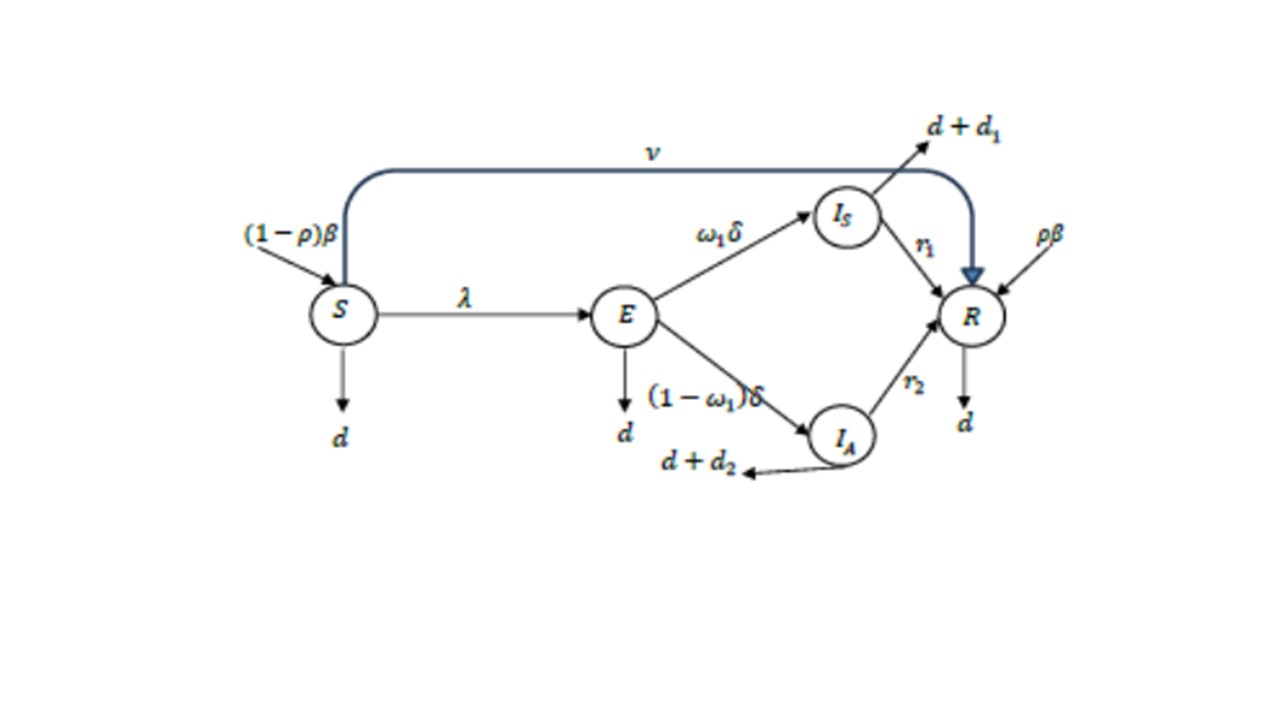
Fowl pox is a highly contagious viral disease that poses significant economic challenges to poultry production through reduced productivity, morbidity, and mortality. This study extends an existing fowl pox transmission model by incorporating vaccination of susceptible and newly recruited birds, culling of symptomatic infectious birds, and separate symptomatic and asymptomatic infectious classes to better capture disease progression and control dynamics. A deterministic compartmental model consisting of susceptible, exposed, symptomatic infectious, asymptomatic infectious, and recovered bird populations is formulated and analyzed. Fundamental properties of the model, including positivity and boundedness of solutions, are established. The disease-free equilibrium and the basic reproduction number are derived using the next-generation matrix approach. Using biologically relevant parameter values, the basic reproduction number was evaluated as , indicating that each infectious bird generates less than one secondary infection on average. Theoretical analysis shows that the disease-free equilibrium is both locally and globally asymptotically stable whenever . Sensitivity analysis reveals that the culling rate and vaccination rate exert the strongest negative influence on disease transmission, with sensitivity indices of and , respectively, while the symptomatic transmission coefficient and recruitment rate contribute most positively to disease spread. Numerical simulations demonstrate that increasing vaccination coverage and culling rates substantially reduce the exposed, symptomatic, and asymptomatic infectious bird populations while increasing the recovered population. The results indicate that the combined implementation of vaccination and culling is an effective strategy for suppressing fowl pox transmission and preventing disease persistence in poultry populations. These findings provide quantitative support for the adoption of integrated vaccination and culling programmes in poultry farms and contribute to the mathematical understanding of fowl pox control.
References
Afonso, C. L., Tulman, E. R., Lu, Z., Zsak, L., Kutish, G. F., & Rock, D. L. (2000). The genome of fowlpox virus.Journal of Virology, 74(8), 3815–3831.
Agwu, I. A., Inyama, S. C., Umana R. A., Omame, A., Ukanwoke, N. Ofomata, A., Mbachu, H. I., Udofia, E. S., Uwakwe, J. I. (2018). Determining the Impact of Variation of Harvesting Effort on the Qualitative Behaviour of a Coexistence Steady State Solution and Its Stability in Prey -Predetor
Fishery Model. Academic Journal of Applied Mathematical Sciences, ISSN(e): 2415-2188, ISSN(p): 2415-5225, 4(10), 119-128.
Ahman, Q. O., Aja, R. O., Omale, D., & Okpara, P. A. (2025). Mathematical modeling of dengue virus transmission: Exploring vector, vertical, and sexual pathways with sensitivity and bifurcation analysis. BMC Infectious Diseases, 25, 1–28.
Akinyemi, S. T., Idisi, I. O., Rabiu, M., Okeowo, V. I., Iheonu, N., Dansu, E. J., Abah, R. T., Mogbojuri, O. A., Audu, A. M., Yahaya, M. M., Ebimobowei, J. S., Akande, K. B., Ojoma, A. A., Adeniji, A. A., & Oshinubi, K. (2023). A tale of two countries: Optimal control and cost-effectiveness analysis of monkeypox disease in Germany and Nigeria. Healthcare Analytics, 4, 1–27.
Alehegn, E., Chanie, M., & Mengesha, D. (2014). A systematic review of serological and clinicopathological features and associated risk factors of avian pox. British Journal of Poultry Science, 3, 78–87.
Anjam, Y. N., Ishfaq, K., Cheema, S. A., Saleem, S. M. N., & Farman, M. (2024). Estimating the dynamics of the drinking epidemic model with control interventions: A sensitivity analysis. Nonlinear Engineering, 13, 1–20.
Ariyoshi, R., Takase, K., Matsuura, Y., Deguchi, K., Ginnaga, A., & Fujikawa, H. (2003). Vaccination against fowlpox virus via drinking water. Journal of Veterinary Medical Science, 65(10), 1127–1130.
Buller, R. M., & Palumbo, G. J. (1991). Poxvirus pathogenesis. Microbiological Reviews, 55(1), 80–122.
Castillo-Chavez, C., & Song, B. (2004). Dynamical models of tuberculosis and their applications. Mathematical Biosciences and Engineering, 2, 361–404.
Chiganga, S. R., Maranya, M. M., Nkuba, N., & Farai, N. (2025). Exploring the role of funding-driven vaccination in infection dynamics of tuberculosis: A mathematical modeling approach. Scientific African, 29, 1–18.
Duru, E. C., Anyanwu, M. C., & Mbah, G. C. E. (2025). Mathematical analysis of a malaria model with vaccination, treatment and vector control using sterile-insect technique. Journal of Mathematical Analysis and Modelling, 6(2), 82–106.
Duru, E. C., Anyanwu, M. C., &Mbah, G. C. E. (2025). A mathematical model to investigate the effect of misdiagnosis and wrong treatment in the co-circulation and co-infection of malaria and Zika virus disease. Bulletin of Biomathematics, 3(1), 79–110.
E.S. Udofia, J.I. Uwakwe, and H.S. Thomas (2024) Optimal control and sensitivity analysis of age-structured mathematical model of Diphtheria infection, International Journal of Mathematical Analysis and Modelling (2024) 7(1):122–143
Francis, J. (1956). Methods of infection and immunity in fowlpox. Australian Veterinary Journal, 32(8), 216–220.
Gulbudak, H., & Martcheva, M. (2014). A structured avian influenza model with imperfect vaccination and vaccine-induced asymptomatic infection. Bulletin of Mathematical Biology, 76(10), 2391–2423.
Herdicho, F. F., Fatmawati, F., Alfiniyah, C., Rois, M. A., Martini, S., Aldila, D., &Nyabadza, F. (2025). Optimal control of dengue hemorrhagic fever model by classifying sex in West Java Province, Indonesia. Scientific Reports, 15, 1–20.
James, D., Ndidiamaka, E. D., & Terhemen, S. A. (2021). Sensitivity analysis of fowlpox infection.Academic Journal of Statistics and Mathematics, 7.
Naandam, S. M., Chataa, P., & Gogovi, G. K. (2025). A mathematical model for bed bug infestation dynamics with limited disinfestation. Journal of Applied Mathematics, 2025, Article 9981379, 1–15.
Nana-Kyere, S., Seidu, B., & Nantomah, K. (2024). Mathematical analysis of malaria epidemic: Asymptotic stability with cost-effectiveness study. Journal of Applied Mathematics, 2024, Article 5533885, 1–44.
Okwor, E. C., Eze, D. C., & Agbo, I. C. (2018). The effects of vaccination, antibiotic and vitamin therapy on some clinical parameters associated with natural outbreak of fowlpox in chickens. International Journal of Veterinary Medicine and Animal Health, 9(5), 1–4.
Onuoha, J. I., Inyama, S. C. & Udofia, E. S. (2014). Mathematical Model of the Transmission of Swine Flu with the Vaccination of Newborns. International J. of Math. Sci. & Engg. Appls. (IJMSEA), ISSN 0973-9424, 8, 217-229
Onuoha, J. I., Inyama, S. C., Udofia, E. S & Omame, A. (2015). Mathematical Model of the Transmission Dynamics of Swine Flu with the Vaccination of Non-Newborns. International J. of Math. Sci. & Engg. Appls. (IJMSEA), ISSN 0973-9424, Vol. 9 No. I (March, 2015), pp 1-17.
Pathak, S., & Kota, V. R. (2025). An influential study of a time-delayed epidemic model incorporating vaccination and treatment interventions. Advances in Continuous and Discrete Models, 57, 1–24.
Rasheed, A., Raza, A., & Omame, A. (2020). Analysis of a novel mathematical model for HBV and HIV incorporating vertical transmission and intervention measures. Modeling Earth Systems and Environment, 11, 1–20.
Sharma, D., Tripathi, A., &Tripathi, R. N. (2024). Modelling the spread of coronavirus with self-protection and quarantine effect. Applications and Applied Mathematics: An International Journal (AAM), 19, 1–24.
Singh, P., Schnitzlein, W. M., &Tripathy, D. N. (2005). Construction and characterization of a fowlpox virus field isolate whose genome lacks reticuloendotheliosis provirus nucleotide sequences. Avian Diseases, 49(3), 401–408.
Thomas, H. S., Udofia, E. S. & Uwakwe, J. I. (2024). Discrete Delay on the Impact of Media Coverage in the Transmission Dynamics of Fowl Pox Infection, Transactions of the Nigerian Association of Mathematical Physics, 19 (2024) 111-124, https://nampjournals.org.ng.
Thomas, H. S., Udofia, E. S., Akpan, U. D. & Uwakwe, J. I. (2025). Caputo Fractional Derivatives of Age-Structured Diphtheria Infection Model with Laplace Adomian Decomposition Analysis, International Journal of Applied Science and Mathematical Theory E- ISSN 2489-009X, P-ISSN 2695-1908, 11(8), 42-68 www.iiardjournals.org online version
Tripathy, D. N., Schnitzlein, W. M., Morris, P. J., Janssen, D. L., Zuba, J. K., & Massey, G. (2000). Characterization of poxviruses from forest birds in Hawaii. Journal of Wildlife Diseases, 36(2), 225 - 230.
Udofia, E. S, Akpan, U. D., Uwakwe, J. I. & Thomas, H. S. (2024). Age Structured Deterministic Model of Diphtheria Infection. Earthline Journal of Mathematical Sciences, 14(3), 391 – 404.
Udofia, E. S. & Amos, A. I. (2018). Mathematical Model of Bacteria-Nutrient Harvesting in a Cultured Environment. Journal of the Nigerian Association of Mathematical Physics, 46, 115 –118.
Udofia, E. S. & Inyama, S. C. (2011). Mathematical Model of the Impact of Vaccination on the Transmission Dynamics of Fowl Pox in Poultry, Journal of Modern Mathematics and Statistics, 5 (5-6): 102-105.
Udofia, E. S. & Inyama, S. C. (2013), Mathematical Model of Structural Strategy (Delayed First Intercourse) In HIV/AIDS Prevention, Journal of the Nigerian Association of Mathematical Physics, Volume 24 (July, 2013), pp 257 – 260
Udofia, E. S. (2023). Mathematical Model of Male Circumcision in HIV/AIDS Preventions. International Journal of Innovative Science and Research Technology, 8(8), 1462 – 1468.
Udofia, E. S., & Sampson, M. I. (2014). Mathematical model for the epidemiology of fowlpox infection transmission that incorporates discrete delay. IOSR Journal of Mathematics, 10(4), 8–16.
Udofia, E. S., Akpan, U. D., Uwakwe, J. I. & Thomas, H. S. (2024). Mathematical Modeling of Bird Harvesting in Intensive Poultry System, Asian Journal of Probability and Statistics, Volume 26, Issue 2, Page 76-83, 2024; Article no. AJPAS.112594
Udofia, E. S., Udoh, K. J., & Inyama, S. C. (2016). The impact of media coverage on the transmission dynamics of fowlpox in poultry. International Journal of Mathematics Sciences and Engineering Applications, 10(1), 103–114.
Umar, B. N., Adamu, J., Ahmad, M. T., Ahmad, K. H., Sada, A., & Orakpoghenor, O. (2021). Fowlpox virus: An overview of its classification, morphology and genome, replication mechanisms, uses as vaccine vector and disease dynamics. World's Poultry Science Journal, 77(4), 929–948.
Van den Driessche, P., &Watmough, J. (2002). Reproduction numbers and sub-threshold endemic equilibria for compartmental models of disease transmission. Mathematical Biosciences, 180(1–2), 29–48.
Weli, S. C., & Tryland, M. (2011). Avipoxviruses: Infection biology and their use as vaccine vectors. Virology Journal, 8(1), 1–15.
Yeo, G., Wang, Y., Chong, S. M., Humaidi, M., Lim, X. F., & Mailepessov, D. (2019). Characterization of fowlpox virus in chickens and bird-biting mosquitoes: A molecular approach to investigating avipoxvirus transmission. Journal of General Virology, 100(5), 838–850.
Zarin, R., Zeb, A., Alshammari, F. S., Khan, A., & Khalifa, H. A. (2025). Exploring syphilis transmission dynamics with congenital infection and disability compartments. Scientific Reports, 15, 1–35.
Zuhur, A., Mahmoud, H. D., Yousef, A., & Areej, A. (2025). Assessing the role of vaccination in the control of hand, foot and mouth disease transmission. Mathematics, 13, 268–286.
Downloads
Published
How to Cite
Issue
Section
License
Copyright (c) 2026 Researchers Journal of Science and Technology

This work is licensed under a Creative Commons Attribution-NonCommercial-NoDerivatives 4.0 International License.
Unless a different licence is clearly indicated for a particular article, articles published in the journal are made available under the Creative Commons Attribution 4.0 International (CC BY 4.0) licence. This licence permits others to read, download, copy, distribute, share, adapt, and build upon the published work, including for commercial purposes, provided that appropriate credit is given to the original author(s), the article is properly cited, and any changes made to the original work are clearly indicated.