Prof. Nyakno J. George
Department of Physics
Akwa Ibom State University, Nigeria
Profile
Terms and Conditions
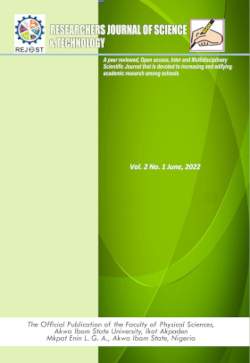
Researchers Journal of Science and Technology
Published by the Faculty of Physical Sciences, Akwa Ibom State University, Nigeria
- Introduction
The Researchers Journal of Science and Technology is committed to providing a credible, fair, and accessible platform for the publication and dissemination of high-quality research in science, technology, and related disciplines. The Journal welcomes original research articles, review papers, technical reports, short communications, and other scholarly contributions that advance knowledge and contribute meaningfully to scientific and technological development.
By submitting a manuscript to the Journal, authors acknowledge and agree to comply with the terms and conditions outlined in this policy.
- Scope of the Journal
The Journal publishes scholarly works in relevant areas of science and technology, including, but not limited to, Physics, Chemistry, Mathematics, Computer Science, Geology, Environmental Science, Statistics, and other related fields.
The Journal may also consider interdisciplinary research where the work demonstrates clear scientific relevance and contributes to the advancement of knowledge.
- Originality of Submitted Manuscripts
Authors must ensure that every manuscript submitted to the Journal is original and has not been published previously, either in whole or in substantial part, in another journal, book, conference proceeding, repository, or other publication outlet.
A manuscript must not be submitted simultaneously to another journal while it is under consideration by the Researchers Journal of Science and Technology. Authors are responsible for informing the Editor-in-Chief if any part of the manuscript has been published previously or is being considered elsewhere.
- Authorship and Responsibility
Authorship should be limited to individuals who have made substantial contributions to the conception, design, execution, analysis, interpretation, or writing of the research.
All listed authors must have:
- made a meaningful contribution to the research;
- participated in the preparation or critical revision of the manuscript;
- approved the final version of the manuscript; and
- agreed to be accountable for the integrity of the work.
Individuals who contributed to the research but do not meet the requirements for authorship should be appropriately acknowledged.
The corresponding author is responsible for ensuring that all listed authors have approved the manuscript and consented to its submission.
- Ethical Conduct and Research Integrity
Authors are expected to conduct and report their research honestly, responsibly, and transparently. The Journal does not tolerate:
- fabrication of research data;
- falsification or manipulation of results;
- plagiarism;
- duplicate publication;
- inappropriate image manipulation;
- undisclosed conflicts of interest; or
- any other form of academic or research misconduct.
Where allegations of misconduct arise, the Journal may investigate the matter and take appropriate action, including rejection, withdrawal, or retraction of the affected publication.
- Plagiarism and Similarity
All submitted manuscripts may be screened for plagiarism and excessive similarity with previously published material.
Authors remain responsible for ensuring that their work properly acknowledges the ideas, words, data, methods, figures, and other materials obtained from other sources. The use of another person's work without appropriate acknowledgement is unacceptable.
Similarity reports may be considered as part of the editorial assessment. However, similarity percentages will not be interpreted in isolation, since legitimate technical terms, references, standard methodological descriptions, and commonly used expressions may contribute to similarity scores.
- Peer Review
Manuscripts considered suitable for publication may undergo peer review by qualified experts in the relevant field.
The Journal seeks to ensure that peer review is:
- fair;
- objective;
- confidential; and
- based on the scientific quality, originality, clarity, and relevance of the manuscript.
The final decision to accept, revise, or reject a manuscript rests with the Editor-in-Chief or the designated editorial authority.
Editorial decisions are based on the quality and suitability of the manuscript and are not guaranteed by the identity, institutional affiliation, academic rank, or personal relationship of any author.
- Editorial Decisions
The possible decisions on a submitted manuscript include:
- Accept;
- Accept subject to minor revisions;
- Major revision required;
- Resubmit for further consideration; or
A request for revision does not guarantee eventual acceptance. Revised manuscripts may be returned to the original reviewers or evaluated by the editorial team, depending on the nature of the required changes.
The Journal reserves the right to reject a manuscript where it does not meet the required scientific, ethical, editorial, or technical standards.
- Manuscript Preparation and Author Guidelines
Authors must prepare and submit manuscripts in accordance with the Journal's current author guidelines.
The Journal may return manuscripts that do not comply with basic submission requirements, including issues relating to:
- manuscript structure;
- formatting;
- references;
- figures and tables;
- language and clarity;
- ethical declarations; or
- required submission information.
The Journal may update its author guidelines from time to time. Authors are expected to follow the guidelines applicable at the time of submission.
- Accuracy and Responsibility for Published Content
Authors are solely responsible for the accuracy, originality, interpretation, and integrity of the content of their published work.
Publication in the Journal does not necessarily imply that the views, conclusions, or opinions expressed in an article are shared by the Faculty of Physical Sciences, Akwa Ibom State University, the Editorial Board, or the University.
Authors should carefully verify all data, calculations, references, figures, tables, affiliations, and other information before final submission.
- Corrections, Retractions, and Withdrawal
The Journal may publish corrections where errors are identified after publication and the errors do not fundamentally affect the validity of the work.
Where serious errors, misconduct, plagiarism, fabricated data, or other significant problems are discovered, the Journal may withdraw or retract the publication.
Requests for withdrawal after acceptance or publication may be considered only where there is a legitimate and compelling reason. Authors should not withdraw manuscripts merely because of a change of mind, delays associated with the publication process, or submission to another journal.
- Copyright and Publishing Rights
Unless otherwise stated by the Journal, authors retain responsibility for the intellectual content of their work while granting the Researchers Journal of Science and Technology the necessary right to publish, reproduce, distribute, archive, and make the published work available through appropriate academic and scholarly platforms.
Authors must ensure that they have obtained permission to reproduce any copyrighted material, including figures, tables, photographs, substantial quotations, or other materials belonging to third parties.
The Journal may request evidence of permission where necessary.
- Open Access and Use of Published Articles
Where the Journal publishes articles through an open-access model, readers may access the published content in accordance with the Journal's applicable copyright and licensing terms.
Authors and readers may cite, share, and use published material in accordance with applicable copyright law and the specific licence under which the article is published.
Any reuse of published material must properly acknowledge the original article and the Researchers Journal of Science and Technology.
- Conflicts of Interest
Authors, reviewers, and editors must disclose any financial, professional, personal, institutional, or other relationships that could reasonably influence their judgement or create the appearance of a conflict of interest.
A conflict of interest does not automatically prevent publication or participation in the review process. However, it should be disclosed so that the Journal can determine the appropriate course of action.
- Funding Disclosure
Authors should disclose all significant sources of financial or institutional support received for the research.
Where applicable, authors should clearly state the role of the funding body in:
- study design;
- data collection;
- analysis;
- interpretation;
- manuscript preparation; and
- the decision to submit the manuscript for publication.
- Human Participants, Animals, and Environmental Research
Research involving human participants, animals, sensitive personal information, or other ethically regulated activities must comply with applicable ethical standards and institutional or regulatory requirements.
Where ethical approval or informed consent is required, authors must provide appropriate information about such approval or consent.
Authors conducting field-based environmental or scientific research are also expected to comply with relevant laws, regulations, institutional requirements, and responsible research practices.
- Data, Materials, and Research Transparency
Authors are encouraged to provide sufficient methodological detail to enable other researchers to understand, evaluate, and, where reasonably possible, reproduce the research.
Where appropriate and legally permissible, authors are encouraged to make relevant datasets, software, analytical procedures, or supplementary materials available to the research community.
The Journal recognizes that certain data may be subject to ethical, legal, privacy, security, or ownership restrictions.
- Reviewers' Responsibilities
Reviewers are expected to:
- maintain the confidentiality of manuscripts;
- provide objective and constructive comments;
- disclose any potential conflict of interest;
- avoid using unpublished information for personal advantage; and
- notify the Editor if they identify possible plagiarism, misconduct, or serious ethical concerns.
Reviewers should not use the review process to promote personal, institutional, or commercial interests.
- Editors' Responsibilities
Editors are expected to manage manuscripts fairly, professionally, and confidentially.
Editorial decisions should be based primarily on the academic and scientific quality of the manuscript.
Editors must not use unpublished information obtained through the editorial process for personal advantage and should disclose any conflict of interest that could affect their decision-making.
- Publication Charges
Where publication, processing, submission, or other charges apply, the Journal shall communicate the applicable fees and conditions to authors through its official channels.
No author should be required to make an unofficial payment to influence editorial or peer-review decisions.
Any approved charges shall be administered in accordance with the Journal's established financial and administrative procedures.
- Advertising and Commercial Influence
The Journal shall maintain editorial independence from commercial, financial, or institutional interests.
Any advertising or sponsorship associated with the Journal must not influence the peer-review process, editorial decisions, or the scientific content of published articles.
- Use of Artificial Intelligence and Digital Tools
Authors may use artificial intelligence or other digital tools to assist with activities such as language improvement, grammar correction, formatting, data analysis, or other appropriate research-support tasks.
However, artificial intelligence tools cannot be listed as authors. Authors remain fully responsible for the accuracy, originality, integrity, and ethical acceptability of the submitted work.
Any use of artificial intelligence that materially contributes to the preparation, analysis, or generation of the manuscript should be disclosed where required by the Journal.
Authors must also ensure that confidential, private, or sensitive research information is not improperly disclosed to external artificial intelligence systems.
- Communication with the Journal
All official communication relating to manuscript submission, peer review, revision, acceptance, publication, or other editorial matters should be conducted through the Journal's designated official communication channels.
Authors are expected to provide accurate contact information and to respond to editorial communications within a reasonable period.
The Journal may discontinue consideration of a manuscript where an author repeatedly fails to respond to essential editorial communications.
- Privacy and Protection of Personal Information
Personal information collected during manuscript submission, peer review, publication, or other Journal activities shall be used primarily for legitimate editorial, administrative, scholarly, and publication-related purposes.
The Journal shall make reasonable efforts to protect personal information and shall not knowingly disclose such information except where required for legitimate editorial, legal, ethical, or administrative purposes.
- Changes to These Terms and Conditions
The Journal reserves the right to revise or update these Terms and Conditions when necessary to reflect changes in scholarly publishing, research ethics, technology, institutional policy, or applicable regulations.
Any revised policy shall apply from the date of its adoption or publication, unless otherwise stated.
- Final Provision
By submitting a manuscript to the Researchers Journal of Science and Technology, authors confirm that they have read, understood, and agreed to comply with these Terms and Conditions.
The Journal is committed to maintaining a publication environment built on academic honesty, fairness, scientific responsibility, respect, transparency, and the advancement of knowledge.
Researchers Journal of Science and Technology
Faculty of Physical Sciences
Akwa Ibom State University
Akwa Ibom State, Nigeria