
An Integrated Machine Learning Framework for Adaptive Cybersecurity Threat Detection
DOI:
https://doi.org/10.83080/rejost.vol6no10.358Keywords:
Cybersecurity, Intrusion Detection, Machine Learning, Deep Learning, Concept Drift, Explainable AI, Threat Intelligence, Adaptive SecurityAbstract
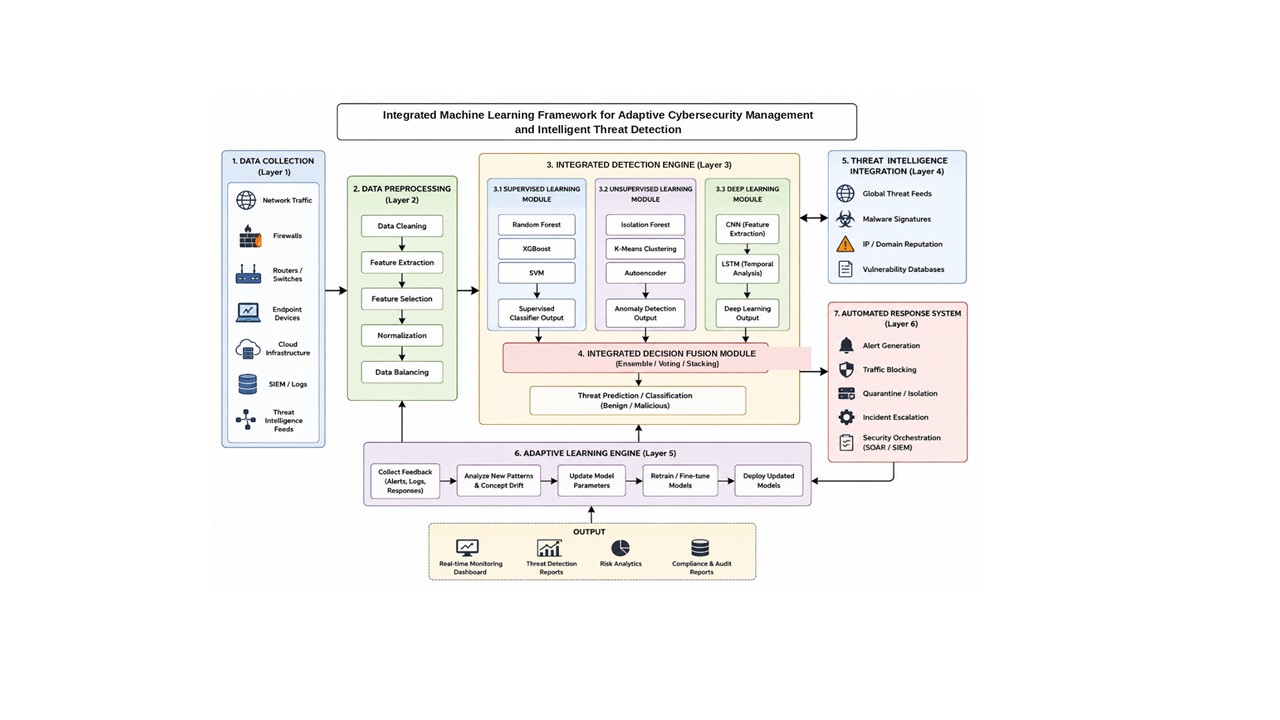
The rapid growth of digital technologies, cloud computing, Internet of Things (IoT), and interconnected networks has significantly increased the frequency and sophistication of cyber threats. Traditional cybersecurity solutions that rely on signature-based detection mechanisms are increasingly ineffective against advanced persistent threats (APTs), zero-day attacks, ransomware, and polymorphic malware. However, individual machine learning (ML) models have limitations, including high false-positive rates, limited adaptability and difficulty detecting previously unseen attacks. This paper proposes an Integrated Adaptive Cybersecurity Framework (IACF) that combines supervised learning (Random Forest, XGBoost, SVM), unsupervised anomaly detection (Isolation Forest, k-means, Autoencoder) and deep learning (CNN, LSTM) within a seven-layer architecture that also incorporates threat intelligence integration, concept-drift-based adaptive learning, automated response and explainable AI (SHAP, LIME). The framework was evaluated on four benchmark datasets; CIC-IDS2017, UNSW-NB15, NSL-KDD and CIC-DDoS2019 using accuracy, precision, recall, F1-score and false positive rate (FPR). Detection accuracy ranged from 98.87% (UNSW-NB15) to 99.85% (CIC-DDoS2019), with corresponding FPR between 0.12% and 0.42%. Under controlled drift-injection experiments, the framework recovered detection accuracy to between 97.6% and 98.9% after concept, feature and adversarial drift. Explainability evaluation with a small panel of security analysts (n = 15) indicated a 43.8% increase in reported trust and a 46% reduction in alert investigation time when SHAP/LIME explanations were provided, and the pipeline processed 1,000 packets in approximately 422 ms on the reported hardware configuration. The principal contribution of the study is the integration of supervised, unsupervised and deep-learning detection with concept-drift adaptation and explainability within a single closed-loop architecture, and an empirical demonstration of its performance on standard intrusion-detection benchmarks.
References
Ahmed, M., Mahmood, A.N. & Hu, J. (2016). A survey of network anomaly detection techniques. Journal of Network and Computer Applications, 60, 19 - 31.
Ahmed, U., Jiangbin, Z., Khan, S. & Sadiq, M.T. (2025). Consensus hybrid ensemble machine learning for intrusion detection with explainable AI. Journal of Network and Computer Applications, 235, 104091
Alaba, F.A., Othman, M., Hashem, I.A.T. & Alotaibi, F. (2017). Internet of Things security: a survey. Journal of Network and Computer Applications, 88, 10–28.
Biggio, B. & Roli, F. (2018). Wild patterns: Ten years after the rise of adversarial machine learning. Pattern Recognition, 84, 317–331.
Buczak, A.L. & Guven, E. (2016). A survey of data mining and machine learning methods for cyber security intrusion detection. IEEE Communications Surveys & Tutorials, 18(2), 1153–1176.
Chandola, V., Banerjee, A. & Kumar, V. (2009). Anomaly detection: a survey. ACM Computing Surveys, 41(3), Article 15.
Dietterich, T.G. (2000). Ensemble methods in machine learning. In: Multiple Classifier Systems. Lecture Notes in Computer Science, vol. 1857. Springer, pp.1–15.
Gama, J., Žliobaitė, I., Bifet, A., Pechenizkiy, M. & Bouchachia, A. (2014). A survey on concept drift adaptation. ACM Computing Surveys, 46(4), Article 44.
Kim, J., Kim, J., Kim, H., Shim, M. & Choi, E. (2020). CNN-based network intrusion detection against denial-of-service attacks. Electronics, 9(6), 916
Lara-Gutierrez, A., Fernandez-Gago, C. & Onieva, J.A. (2025). A framework for drift detection and adaptation in AI-driven anomaly and threat detection systems. Int. J. Inf. Secur. 24, 199. https://doi.org/10.1007/s10207-025-01118-9
Liu, H. & Lang, B. (2019). Machine learning and deep learning methods for intrusion detection systems: a survey. Applied Sciences, 9(20), 4396. https://doi.org/-10.3390/app9204396
Mills, G.A., Acquah, D.K. & Sowah, R.A. (2024). Network intrusion detection and prevention system using hybrid machine learning with supervised ensemble stacking model. Wiley.
Ring, M., Wunderlich, S., Scheuring, D., Landes, D. & Hotho, A. (2019). A survey of network-based intrusion detection data sets. Computers & Security, 86, 147–167.
Sharma, A., Rani, S. & Driss, M. (2024). Hybrid evolutionary machine learning model for advanced intrusion detection architecture for cyber threat identification. PLoS ONE, 19(9). https://doi.org/10.1371/journal.pone.0308206
Shone, N., Ngoc, T.N., Phai, V.D. & Shi, Q. (2018). A deep learning approach to network intrusion detection. IEEE Transactions on Emerging Topics in Computational Intelligence, 2(1), 41–50.
Sommer, R. & Paxson, V. (2010). Outside the closed world: on using machine learning for network intrusion detection. In: Proceedings of the 2010 IEEE Symposium on Security and Privacy, pp.305–316.
Verizon (2023). 2023 Data Breach Investigations Report. Verizon Business.
Zeadally, S., Adi, E., Baig, Z. & Khan, I.A. (2020). Harnessing artificial intelligence capabilities to improve cybersecurity. IEEE Access, 8, 23817 - 23837.
Downloads
Published
How to Cite
Issue
Section
License
Copyright (c) 2026 Maniru Malami Umar, Sadiq Aliyu Ahmad, Bello Alhaji Buhari, Asma’u Shehu

This work is licensed under a Creative Commons Attribution-NonCommercial-ShareAlike 4.0 International License.
Unless a different licence is clearly indicated for a particular article, articles published in the journal are made available under the Creative Commons Attribution 4.0 International (CC BY 4.0) licence. This licence permits others to read, download, copy, distribute, share, adapt, and build upon the published work, including for commercial purposes, provided that appropriate credit is given to the original author(s), the article is properly cited, and any changes made to the original work are clearly indicated.