Machine-Learning Classification of Topological Materials Using Crystallographic and Compositional Descriptors for Pre-DFT Screening
DOI:
https://doi.org/10.83080/rejost.vol6no9.354Keywords:
Topological insulators, Machine learning, SHAP, LightGBM, Materials informaticsAbstract
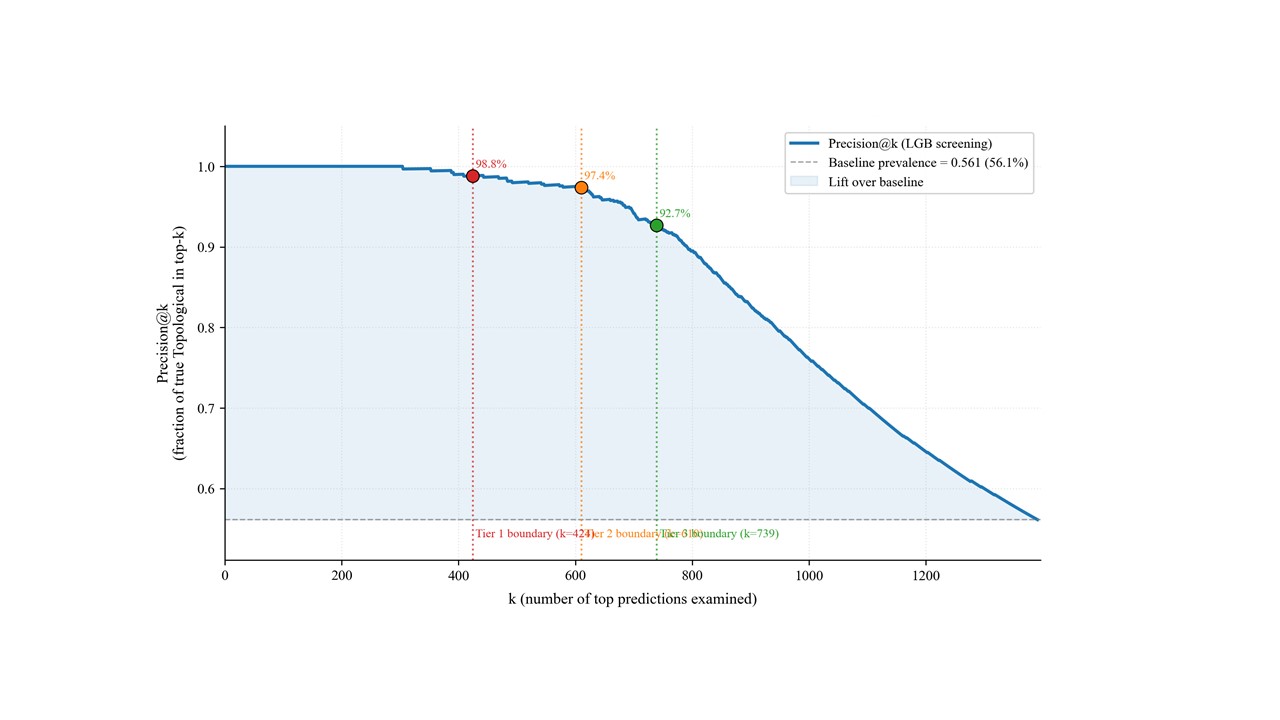
Identifying topological insulators and semimetals among inorganic crystalline materials traditionally requires density functional theory (DFT) calculations with spin–orbit coupling, a computationally expensive process that limits high-throughput screening. This study examined whether machine learning models trained on ground-state crystallographic and compositional descriptors, obtainable without DFT or space-group information, could reliably classify materials as topologically non-trivial, trivial, or semimetallic. A dataset of 1,391 labelled crystalline entries (230 semimetal, 781 topological, 380 trivial), curated from the Inorganic Crystal Structure Database and the Topological Quantum Chemistry database, was cleaned, including manual correction, via direct ICSD lookup, of a systematic lattice-parameter data-entry artefact (an Excel auto-fill error that had propagated a single genuine c-parameter value across 1,208 rows, identified by cross-validation against unit-cell volume), prior to a further, now pipeline-integrated audit that removed 47 true-duplicate ICSD entries and attempted live TQC API resolution of 10 conflicting-label ICSD groups, none of which returned a match, so the first-encountered row was conservatively retained in each case (net reduction from 1,450 to 1,391 entries), and used to engineer 31 structural and compositional features motivated by the physics of spin-orbit-coupling-driven band inversion. Six classifiers, Random Forest, XGBoost, LightGBM, Support Vector Machine, an Artificial Neural Network, and a soft-voting Ensemble, were trained and optimised using nested stratified cross-validation, Bayesian hyperparameter search, and Synthetic Minority Oversampling Technique (SMOTE)-based class rebalancing applied strictly within each training fold. XGBoost produced the highest observed test-set performance (macro-F1 of 0.744, accuracy of 78.1%, macro-AUC-ROC of 0.896), narrowly ahead of LightGBM (macro-F1 0.721, accuracy 74.9%, macro-AUC-ROC 0.887), though the difference was not statistically significant (McNemar's test, p = 1.000, Bonferroni-corrected); LightGBM was retained as the primary model for interpretability and screening on the basis of its lower cross-validation variance and better-behaved post-hoc probability calibration. Shapley Additive exPlanations (SHAP), permutation, and impurity-based feature importance analyses converged on a consistent predictor hierarchy: number of constituent elements, mean ionisation potential, electronegativity range, maximum atomic number, and mean atomic radius, corroborated by polymorph-level diagnostics providing evidence that the model exploits structural, not merely compositional, information in most cases, although structural signal proved insufficient in at least one hard case. Applied to the full dataset, LightGBM ranked 424 entries as Tier 1 (P(Topological) ≥ 0.80) high-confidence topological predictions within the labelled dataset, of which 419 corresponded to already-known topological labels — a precision of 98.8% against known labels (retrospective validation precision, not prospective discovery precision). Interpretability analysis was also used as a data-quality diagnostic, motivating a closer investigation that, together with cross-validation against unit-cell volume and a subsequent ICSD/TQC provenance audit, uncovering and correcting a latent artefact in an earlier version of the model's most important feature. These findings demonstrate that pre-DFT structural and compositional descriptors carry physically plausible and interpretable predictive signal for topological classification, offering an inexpensive pre-screening tool to prioritise candidate materials for further investigation.
References
Bernevig, B. A., Hughes, T. L., & Zhang, S.-C. (2006). Quantum spin Hall effect and topological phase transition in HgTe quantum wells. Science, 314, 1757–1761. https://doi.org/10.1126/science.1133734
Bradlyn, B., Elcoro, L., Cano, J., Vergniory, M. G., Wang, Z., Felser, C., Aroyo, M. I., & Bernevig, B. A. (2017). Topological quantum chemistry. Nature, 547, 298–305. https://doi.org/10.1038/nature23268
Breiman, L. (2001). Random forests. Machine Learning, 45, 5–32. https://doi.org/-10.1023/A:1010933404324
Cao, G., Ouyang, R., Barrón-Palos, L., Zhou, J., Fu, Y., Dong, B., & Ma, Y. (2020). Artificial intelligence for high-throughput discovery of topological insulators: The example of alloyed tetradymites. Physical Review Materials, 4, 034204. https://-doi.org/10.1103/PhysRevMaterials.4.034204
Chawla, N. V., Bowyer, K. W., Hall, L. O., & Kegelmeyer, W. P. (2002). SMOTE: Synthetic minority over-sampling technique. Journal of Artificial Intelligence Research, 16, 321–357. https://doi.org/10.1613/jair.953
Chen, T., & Guestrin, C. (2016). XGBoost: A scalable tree boosting system. In Proceedings of the 22nd ACM SIGKDD International Conference on Knowledge Discovery and Data Mining, (pp. 785–794). https://doi.org/10.1145/2939672.2-939785
Claussen, N., Bernevig, B. A., & Regnault, N. (2020). Detection of topological materials with machine learning. Physical Review B, 101, 245117. https://doi.org/10.1103/-PhysRevB.101.245117
Cortes, C., & Vapnik, V. (1995). Support-vector networks. Machine Learning, 20, 273–297. https://doi.org/10.1007/BF00994018
Fu, L., & Kane, C. L. (2007). Topological insulators with inversion symmetry. Physical Review B, 76, 045302. https://doi.org/10.1103/PhysRevB.76.045302
Fu, L., Kane, C. L., & Mele, E. J. (2007). Topological insulators in three dimensions. Physical Review Letters, 98, 106803. https://doi.org/10.1103/PhysRev-Lett.98.106803
Kane, C. L., & Mele, E. J. (2005). Z₂ topological order and the quantum spin Hall effect. Physical Review Letters, 95, 146802. https://doi.org/10.1103/PhysRevLett.95.146802
Ke, G., Meng, Q., Finley, T., Wang, T., Chen, W., Ma, W., Ye, Q., & Liu, T.-Y. (2017). LightGBM: A highly efficient gradient boosting decision tree. In Advances in Neural Information Processing Systems, 30, 3146–3154. https://proceedings-.neurips.cc/paper/2017/hash/6449f44a102fde848669bdd9eb6b76fa-Abstract.html
König, M., Wiedmann, S., Brüne, C., Roth, A., Buhmann, H., Molenkamp, L. W., Qi, X.-L., & Zhang, S.-C. (2007). Quantum spin Hall insulator state in HgTe quantum wells. Science, 318, 766–770. https://-doi.org/10.1126/science.1148047
Louis, S.-Y., Zhao, Y., Nasiri, A., Wang, X., Song, Y., Liu, F., & Hu, J. (2020). Graph convolutional neural networks with global attention for improved materials property prediction. Physical Chemistry Chemical Physics, 22, 18141–18148. https://-doi.org/10.1039/D0CP01474E
Lundberg, S. M., & Lee, S.-I. (2017). A unified approach to interpreting model predictions. In Advances in Neural Information Processing Systems, 30, 4765–4774.
Moore, J. E., & Balents, L. (2007). Topological invariants of time-reversal-invariant band structures. Physical Review B, 75, 121306. https://doi.org/10.1103/PhysRevB.75.121306
Schleder, G. R., Focassio, B., and Fazzio, A. (2021). Machine learning for materials discovery: Two-dimensional topological insulators. Applied Physics Reviews, 8, 031414.https://doi.org/10.1063/5.0055035
Sun, Q., Bhatt, M., & Bhattacharya, S. (2018). Machine learning approaches for the prediction of materials properties. Computational and Theoretical Chemistry, 1127, 51–55. https://doi.org/-10.1016/j.comptc.2018.02.009
Vergniory, M. G., Elcoro, L., Felser, C., Regnault, N., Bernevig, B. A., & Wang, Z. (2019). A complete catalogue of high-quality topological materials. Nature, 566, 480–485. https://doi.org/10.1038/s41586-019-0954-4
Vergniory, M. G., Wieder, B. J., Elcoro, L., Parkin, S. S. P., Felser, C., Bernevig, B. A., & Regnault, N. (2022). All topological bands of all nonmagnetic stoichiometric materials. Science, 376, 6595. https://-doi.org/10.1126/science.abg9094
Downloads
Published
How to Cite
Issue
Section
License

This work is licensed under a Creative Commons Attribution-NonCommercial-ShareAlike 4.0 International License.
Unless a different licence is clearly indicated for a particular article, articles published in the journal are made available under the Creative Commons Attribution 4.0 International (CC BY 4.0) licence. This licence permits others to read, download, copy, distribute, share, adapt, and build upon the published work, including for commercial purposes, provided that appropriate credit is given to the original author(s), the article is properly cited, and any changes made to the original work are clearly indicated.