Isolation and Characterization of Acetic Acid Bacteria from Orange and Watermelon Peel Wastes in Ilorin, Nigeria
DOI:
https://doi.org/10.83080/rejost.vol6no9.351Keywords:
Acetic acid bacteria, Fruit peel waste, Orange, Watermelon, Acetobacter aceti, Gluconobacter oxydansAbstract
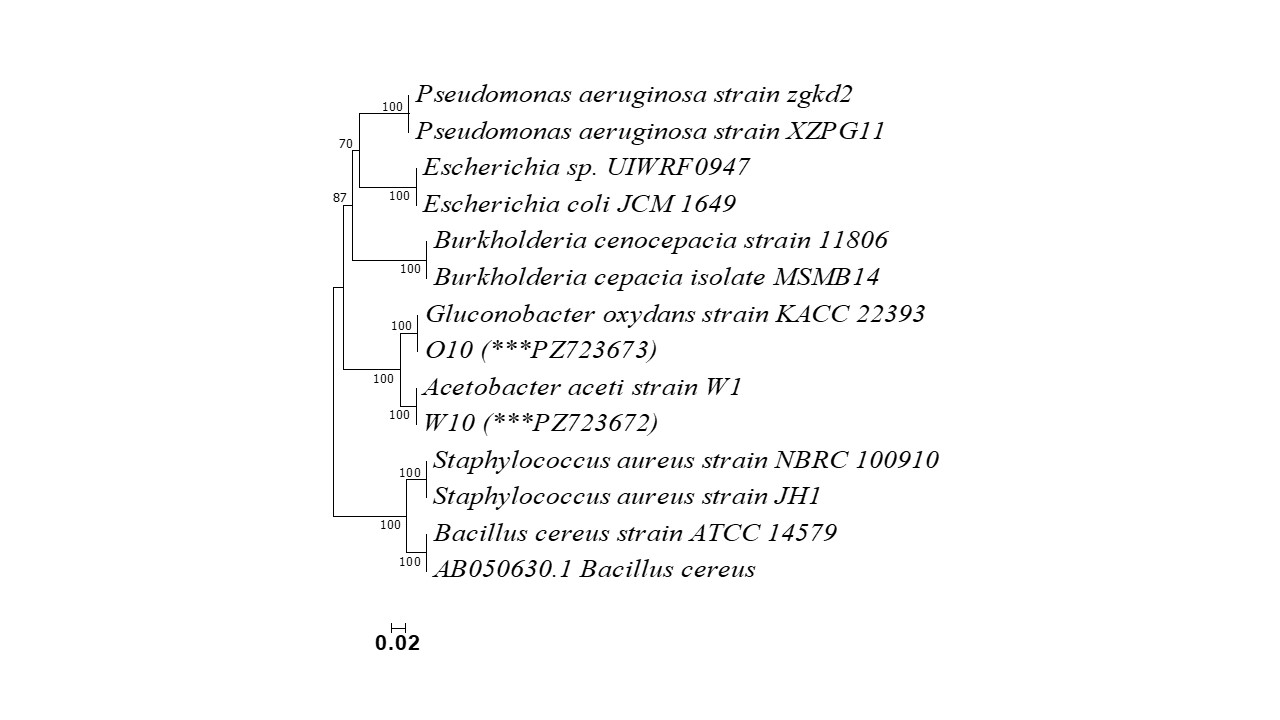
Fruit peel wastes may serve as inexpensive sources of acetic acid bacteria (AAB) for biotechnological applications. This study investigated the isolation and characterization of AAB from orange (Citrus sinensis) and watermelon (Citrullus lanatus) peels obtained from Ipata Market, Ilorin, Kwara State, Nigeria. The samples were subjected to enrichment and serial dilution, followed by isolation on Glucose Yeast Calcium Carbonate Agar (GYC). Presumptive isolates were characterized using cultural, morphological and biochemical tests and screened for oxidizing activity on Carr’s medium. Total heterotrophic bacterial counts were 1.60 ± 0.20 ×10⁵ CFU/g for watermelon peel and 1.50 ± 0.30 × 10⁵ CFU/g for orange peel, while presumptive AAB counts were 2.20 ± 0.20 × 10³ and 4.80 ±1.40 × 10² CFU/g, respectively. Two presumptive AAB isolates were recovered. Based on phenotypic and biochemical characteristics, the isolates were assigned to Acetobacter sp. and Gluconobacter sp. 16S rRNA gene sequencing identified representative isolates as Acetobacter aceti and Gluconobacter oxydans. The findings demonstrate that orange and watermelon peels harbour AAB and may serve as accessible sources of potentially useful strains for further investigation of acetic acid fermentation and other biotechnological applications.
References
Dienye, B. N., Agwa, O. K., Akponiya, P. E., Peter, C. P. & Princewill, C. D. (2025). Isolation of bacteria with acetic acid production potential from selected fruits and soil. UMYU Journal of Microbiology Research, 10(2), 255–267. https://doi.org/10.47430/ujmr.25102.027
Fawole, M. O., & Oso, B. A. (2007). Laboratory manual of microbiology (5th ed.). Spectrum Books Limited.
Galanakis, C. M. (2021). Functionality of food components and emerging technologies. Foods, 10(1), 128. https://doi.org/1-0.3390/foods10010128
Gomes, R. J., Borges, M. F., Rosa, M. F., Castro-Gómez, R. J. H. & Spinosa, W. A. (2018). Acetic acid bacteria in the food industry: Systematics, characteristics and applications. Food Technology and Biotechnology, 56(2), 139–151. https://-doi.org/10.17113/ftb.56.02.18.5593
Han, D., Yang, Y., Guo, Z., Dai, S., Jiang, M., Zhu, Y., Wang, Y., Yu, Z., Wang, K., Rong, C., & Yu, Y. (2024). A review on the interaction of acetic acid bacteria and microbes in food fermentation: A microbial ecology perspective. Foods, 13(16), 2534. https://doi.org/10.3390/-foods13162534
Hua, S., Wang, Y., Wang, L., Zhou, Q., Li, Z., Liu, P., Wang, K., Zhu, Y., Han, D. & Yu, Y. (2024). Regulatory mechanisms of acetic acid, ethanol and high temperature tolerances of acetic acid bacteria during vinegar production. Microbial Cell Factories, 23(1), 324. https://doi.org/10.1186/s12934-024-02602-y
Li, M.-N., Han, Q., Wang, N., Wang, T., You, X.-M., Zhang, S., Zhang, C.-C., Shi, Y.-Q., Qiao, P.-Z., Man, C.-L., Feng, T., Li, Y.-Y., Zhu, Z., Quan, K.-J., Xu, T.-L. & Zhang, G. F. (2024). 16S rRNA gene sequencing for bacterial identification and infectious disease diagnosis. Biochemical and Biophysical Research Communications, 739, 150974. https://-doi.org/10.1016/j.bbrc.2024.150974
Martani, N. S., Hanasia, H., Turnip, O. N., Halik, H. & Adnyana, I. G. H. E. (2025). Isolation and characterization of acetic acid bacteria from pineapple peel fermentation (Ananas comosus). Biodiversitas, 26(2), 789–798. https://-doi.org/10.13057/biodiv/d260227
Narimatsu, A., Murakami, K., Kataoka, N., Yamashita, R., Matsushita, K., Matsutani, M., Tippayasak, U., Theeragool, G. & Yakushi, T. (2025). Evidence for ethanol-dependent acetic acid resistance in Acetobacter pasteurianus strain SKU1108. Applied and Environmental Microbiology, 91(12). https://doi.org/10.1128/aem.02-034-25
Obumneme, O. S., Kenneth, E. I., Owuna, A. M., Joseph, G. M. B., Cornelius, O. & Ado, A. (2019). Assessment of microbiological quality of air environment around waste dumpsites within Keffi Metropolis in Northern Nigeria. American Journal of Biological and Environmental Statistics, 5(4), 78–84. https://doi.org/10.11648/j.ajbes.201-90504.13
Rahman, M., Uddin, M. B., Aziz, M. G., Abunaser, M., Haque, M. R. & Siddiki, M. S. R. (2024). Isolation and characterization of acetic acid bacteria from pineapple, sugarcane, apple, grape, pomegranate, and papaya fruit. European Journal of Agriculture and Food Sciences, 6(2), 14–18. https://doi.org/10.24018/ejfood.2024.6.2.772
Román-Camacho, J. J., García-García, I., Santos-Dueñas, I. M., García-Martínez, T. & Mauricio, J. C. (2023). Latest trends in industrial vinegar production and the role of acetic acid bacteria: Classification, metabolism, and applications A comprehensive review. Foods, 12(19), 3705. https://doi.org/-10.3390/foods12193705
Sarker, A., Ahmmed, R., Ahsan, S. M., Rana, J., Ghosh, M. K. & Nandi, R. (2024). A comprehensive review of food waste valorization for the sustainable management of global food waste. Sustainable Food Technology, 2(1), 48–69. https://doi.org/10.1039/D3FB0015-6C
Tripathi, N., Zubair, M., & Sapra, A. (2025, March 28). Gram staining. In StatPearls. StatPearls Publishing. https://www.n-cbi.nlm.nih.gov/books/NBK562156/
YassunakaHata, N. N., Surek, M., Sartori, D., Vassoler Serrato, R. & Aparecida Spinosa, W. (2023). Role of acetic acid bacteria in food and beverages. Food Technology and Biotechnology, 61(1), 85–103. https://doi.org/10.17113/ftb.61-.01.23.7811
Downloads
Published
How to Cite
Issue
Section
License

This work is licensed under a Creative Commons Attribution-NonCommercial-ShareAlike 4.0 International License.
Unless a different licence is clearly indicated for a particular article, articles published in the journal are made available under the Creative Commons Attribution 4.0 International (CC BY 4.0) licence. This licence permits others to read, download, copy, distribute, share, adapt, and build upon the published work, including for commercial purposes, provided that appropriate credit is given to the original author(s), the article is properly cited, and any changes made to the original work are clearly indicated.