Carbon Footprint Inventory and Sectoral Emission Analysis of Government Ministries in Akwa Ibom State, Nigeria
DOI:
https://doi.org/10.83080/rejost.vol6no7.333Keywords:
Carbon footprint, Carbon dioxide, Government Ministries, Climate Change, Sustainability, Akwa Ibom StateAbstract
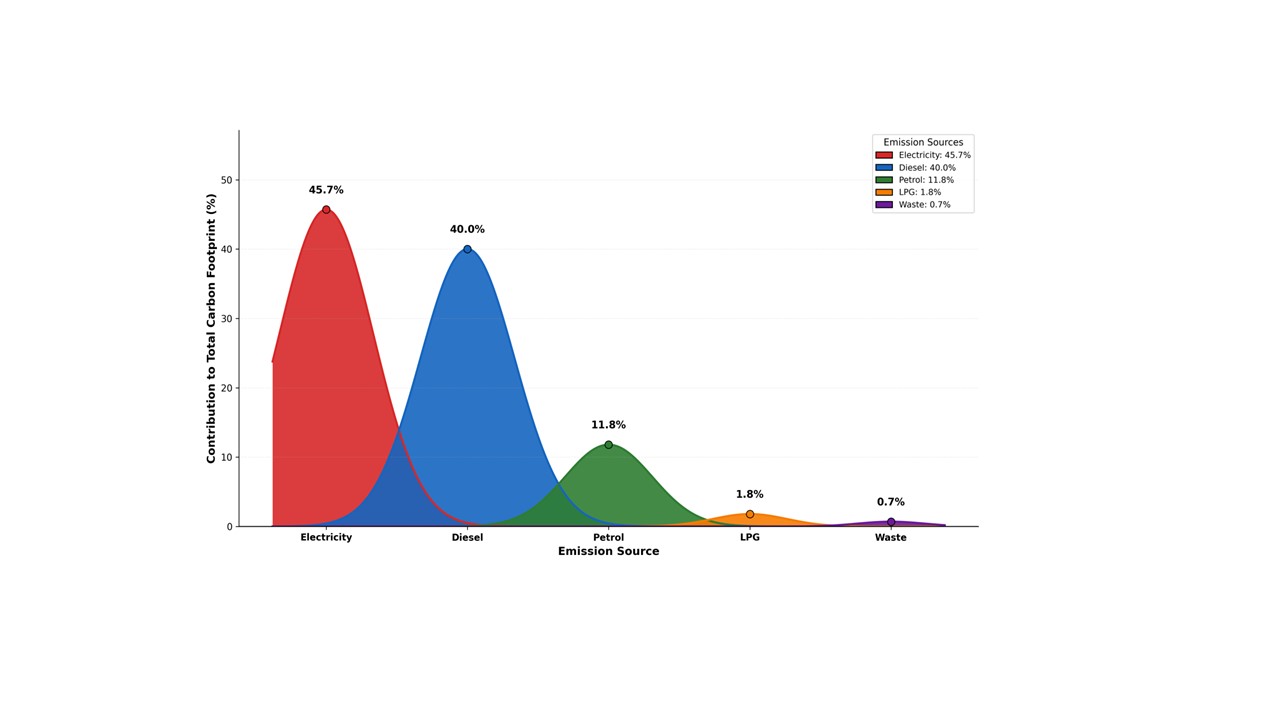
Climate change remains a major environmental concern, while information on carbon emissions from public-sector institutions in developing regions remains limited. This study assessed the carbon footprint and emission contributions of selected government ministries and canteens in Akwa Ibom State, Nigeria, to establish a localized baseline for public-sector carbon management. A survey research design was adopted, and activity data were collected between October 2024 and October 2025 from electricity records, fuel records, canteen consumption records, and waste-related records. Carbon dioxide (CO₂) emissions associated with electricity, diesel, petrol, liquefied petroleum gas (LPG), and waste were estimated using activity data and corresponding emission factors within the Greenhouse Gas Protocol framework. The total estimated carbon footprint of the assessed units was 152,081.130 kg CO₂/year, equivalent to approximately 152.08 tonnes CO₂/year. The Ministry of Justice recorded the highest contribution (13.53%), followed by the Ministries of Finance (11.75%), Housing (9.02%), and Works (8.16%). Electricity was the largest individual emission source, accounting for 45.7% of the total carbon footprint, followed by diesel (40.0%), petrol (11.8%), LPG (1.8%), and waste (0.7%). Pearson correlation analysis further examined relationships among the recorded resource-consumption variables. The findings provide localized baseline evidence of ministry-level carbon emissions and identify electricity and diesel consumption as the principal emission sources requiring attention. The study recommends improved energy efficiency, reduced dependence on diesel-powered generators, renewable energy adoption, sustainable transportation practices, and regular institutional carbon-footprint monitoring to support emission reduction and sustainability within the public sector of Akwa Ibom State.
References
Adewuyi, A. O., & Awodumi, O. B. (2017). Renewable and non-renewable energy-growth-emissions linkages: Review of emerging trends with policy implications. Renewable and Sustainable Energy Reviews, 69, 275–291. https://doi.org/10.1016/j.rser.2-016.11.178
Adhikari, B., Dangal, A., Pandey, S., Thapa, B., Joshi, A., & Baral, B. (2024). Carbon footprint of nepalese healthcare system: A study of dhulikhel hospital. F1000 Research, 12, 1366.
Akwa Ibom State Government. (2025). Ministries. https://akwaibomstate.gov.-ng/ministries/
Breeze. (2022, January 25). Electricity: Nigeria: Nigeria: Operating margin grid emission factor: IFI. https://mybreeze.app/ef/electricity---nigeria---nigeria---operating-margin-grid-emission-factor---ifi---2022-01-25.
Chen, G., Shan, Y., Hu, Y., Tong, K., Wiedmann, T., Ramaswami, A., ... & Wang, Y. (2019). Review on city-level carbon accounting. Environmental science & technology, 53(10), 5545-5558.
Dong, Y., Guo, X., Wang, M., & Xu, J. (2024). Modeling carbon intensity of electric vehicles in the well-to-wheels phase under different traffic flow conditions. Iscience, 27(10).
Ekanem, A. M. (2022). AVI- and GOD-based vulnerability assessment of aquifer units: a case study of parts of Akwa Ibom State, Southern Niger Delta, Nigeria. Sustain. Water Resource Manag. 8, 29. https://doi.org/10.1007/s40899-022-00628-x
Fenner, A. E., Kibert, C. J., Woo, J., Morque, S., Razkenari, M., Hakim, H., & Lu, X. (2018). The carbon footprint of buildings: A review of methodologies and applications. Renewable and Sustainable Energy Reviews, 94, 1142–1152. https://doi.org/10.1016/j.rser.-2018.07.012
Frank, A. (2025, February 25). Akwa Ibom creates four ministries. The Whistler. https://thewhistler.ng/akwa-ibom-creates-four-ministries/
Friedlingstein, P., O’Sullivan, M., Jones, M. W., Andrew, R. M., Bakker, D. C. E., Hauck, J., Landschützer, P., Le Quéré, C., Li, H., Luijkx, I. T., Peters, G. P., Peters, W., Pongratz, J., Schwingshackl, C., Sitch, S., Canadell, J. G., Ciais, P., Aas, K. S., Alin, S. R., Anthoni, P., Barbero, L., Bates, N. R., Bellouin, N., Benoit-Cattin, A., Berghoff, C. F., Bernardello, R., Bopp, L., Brasika, I. B. M., Chamberlain, M. A., Chandra, N., Chevallier, F., Chini, L. P., Colligan, T. H., Collin, R., Couglan, M., Cronin, M., Dou, X., Enyo, K., Evans, W., Feely, R. A., Feng, L., Ford, D. J., Foster, A., Fransner, F., Gasser, T., Gehlen, M., Gkritzalis, T., Gonçalves de Souza, J., Grassi, G., Gregor, L., Gruber, N., Guenet, B., Gürses, Ö., Harrington, K., Harris, I., Hauck, J., Heinke, J., Hurtt, G. C., Iida, Y., Ilyina, T., Ito, A., Jacobson, A. R., Jain, A. K., R., Jain, A. K., Jarníková, T., Jersild, A., Jiang, F., Jones, S. D., Kato, E., Keeling, R. F., Klein Goldewijk, K., Knauer, J., Kong, Y., Korsbakken, J. I., Koven, C., Kunimitsu, T., Lan, X., Liu, J., Liu, Z., Liu, Z., Lo Monaco, C., Marland, G., McGuire, P. C., McKinley, G. A., Melton, J. R., Monacci, N., Monier, E., Morgan, E. J., Munro, D. R., Müller, J. D., Nakaoka, S.-I., Niwa, Y., Nützel, T., Olsen, A., Omar, A. M., Pandey, S., Pierrot, D., Qin, Z., Regnier, P., Rehder, G., Resplandy, L., Roobaert, A., Rosan, T. M., Rödenbeck, R., Rosan, T. M., Schwinger, J., Séférian, R., Sitch, S., Smallman, T. L., Spada, V., Sreeush, M. G., Sun, Q., Sutton, A. J., Sweeney, C., Swingedouw, D., Takao, S., Tatebe, H., Tian, H., Tian, X., Tilbrook, B., Tsujino, H., Tubiello, F., van der Werf, G. R., van der Velde, S. J., Walker, A. P., Wanninkhof, R., Yang, X., Yuan, W., Yue, X., & Zeng, J. (2026). Global Carbon Budget 2025. Earth System Science Data, 18(5), 3211–3288. https://doi.org/10.5194/essd-18-3211-2026
Gao, T., Liu, Q., & Wang, J. (2014). A comparative study of carbon footprint and assessment standards. International Journal of Low-Carbon Technologies, 9, 237–243.
George, N. J., Bassey, N. E., Ekanem, A. M. & Thomas, J. E. (2020). Effects of anisotropic changes on the conductivity of sedimentary aquifers, southeastern Niger Delta, Nigeria. Acta Geophyisca, 68(6) 1833 – 1843. https://doi.org/-10.1007/s11600-020-00502-4
George, N. J., Ekanem, A. M., Thomas, J. E. & Harry T. A. 2022). Modelling the effect of geo-matrix conduction on the bulk and pore water resistivity in hydrogeological sedimentary beddings. Modeling Earth Systems and Environment, 8 (1), 1335-1349. https://doi.org/10.1007/s40808-021-01161-0
George, N.J., Obianwu, V.I., Akpabio, G.T. & Obot, I.B. (2010). Comparison of thermal insulation efficiency of some select materials used as ceiling in building design, Archives of Applied Science Research, 2 (3): 253-259
Gershon, O., & Patricia, O. (2019). Carbon (CO₂) footprint determination: An empirical study of families in Port Harcourt. IOP Conference Series: Journal of Physics, 1299, 012019.
Groves, R. M., Fowler, F. J., Couper, M. P., Lepkowski, J. M., Singer, E., & Tourangeau, R. (2009). Survey methodology. Wiley.
Hertwich, E. G., & Peters, G. P. (2009a). Carbon footprint of nations: A global, trade-linked analysis. Environmental Science & Technology, 43(16), 6414–6420. https://doi.org/10.1021/es803496a
Hertwich, E. G., & Peters, G. P. (2009b). The case for consumption-based accounting of greenhouse gas emissions. Environmental Science & Technology, 43(19), 7926–7931.
Intergovernmental Panel on Climate Change. (2006). 2006 IPCC guidelines for national greenhouse gas inventories. Institute for Global Environmental Strategies. https://www.ipcc.ch/report-/2006-ipcc-guidelines-for-national-greenhouse-gas-inventories/20/
Intergovernmental Panel on Climate Change. (2021). Climate change 2021: The physical science basis. Cambridge University Press. https://www.ipcc.ch/-report/ar6/wg1/about/how-to-cite-this-report/
Intergovernmental Panel on Climate Change. (2023). Climate change 2023: Synthesis report. IPCC. https://www.ipcc.ch-/report/sixth-assessment-report-cycle/
International Financial Institutions Technical Working Group on Greenhouse Gas Accounting. (2022). IFI default grid factors 2021 v3.1. United Nations Framework Convention on Climate Change. https://unfccc.int/documents-/437880
IRENA, R. E. S. (2020). International renewable energy agency. Abu Dhabi, 2020.
Jahami, M. S. (2025). Advancing Sustainable Transportation and Aviation: A Multi-Scale Analysis of Zero-Emission Vehicles, Green Hydrogen Production, and E-Fuel Integration. The University of Alabama.
Lackner, M., Schneider, S., Bachleitner, F., Frech, C., Fritscher, G., Schindler, M., ... & Trampert, M. (2025). Energy efficiency: Comparison of different systems and technologies. In Handbook of climate change mitigation and adaptation (pp. 515-613). Cham: Springer Nature Switzerland.
Larsen, H. N., & Hertwich, E. G. (2009). The case for consumption-based accounting of greenhouse gas emissions to promote local climate action. Environmental Science & Policy, 12(7), 791–798. https://doi.org/10.1016/j.envsci.2009.07.010
Lee, G., Kim, H., Min, K., Hwang, T., Kim, E., Lee, J., & Kang, D. (2025). Carbon emission reduction strategies in urban water sectors: A case study in Incheon Metropolitan city, South Korea. Sustainability, 17(5), 1887.
Ogunjuyigbe, A. S. O., Ayodele, T. R., & Akinola, O. A. (2016). Electricity crisis in Nigeria: The way forward. Energy and Power Engineering, 8(4), 180–191.
Osabohien, R., Akpa, A. F., Olonade, O. Y., Jaaffar, A. H., & Al-Faryan, A. S. (2026). Advancing environmental management through renewable energy and carbon footprint reduction. International Journal of Energy Research, 2026(1), 8136569.
Román, Á. F. G., & Kabir, G. (2024). Assessing carbon dioxide emissions in manufacturing industries: a systematic review. Energies, 17(20), 5119.
Sakata, S., Aklilu, A. Z., & Pizarro, R. (2024). Greenhouse gas emissions data: Concepts and data availability.
Udosen, N. I., Ekanem, A. M., & George, N.J. (2024). Appraisal of flood-prone litho-stratigraphic units via geo electrical technology. Malaysian Journal of Geosciences (MJG), 8(1), 26 - 37.
United Nations Environment Programme. (2023). Emissions gap report 2023. UNEP.
Wiedmann, T., & Minx, J. (2008). A definition of “carbon footprint.” In C. C. Pertsova (Ed.), Ecological economics research trends (pp. 1–11). Nova Science Publishers.
Wikurendra, E. A., Csonka, A., Nagy, I., & Nurika, G. (2024). Urbanization and benefit of integration circular economy into waste management in Indonesia: A Review. Circular Economy and Sustainability, 4(2), 1219-1248
World Business Council for Sustainable Development, & World Resources Institute. (2001). Greenhouse gas protocol: A corporate accounting and reporting standard. World Resources Institute.
World Business Council for Sustainable Development, & World Resources Institute. (2004). The greenhouse gas protocol: A corporate accounting and reporting standard (Revised edition). World Resources Institute.
Yakubu, M. K., Ibrahim, A., & Abdullahi, S. (2021). Assessment of carbon emissions from energy consumption in selected public institutions in Nigeria. Journal of Environmental Management and Sustainability, 10(2), 45–58.
Yaman, C. (2024). A review on the process of greenhouse gas inventory preparation and proposed mitigation measures for reducing carbon footprint. Gases, 4(1), 18-40.
Downloads
Published
How to Cite
Issue
Section
License

This work is licensed under a Creative Commons Attribution-NonCommercial-ShareAlike 4.0 International License.
Unless a different licence is clearly indicated for a particular article, articles published in the journal are made available under the Creative Commons Attribution 4.0 International (CC BY 4.0) licence. This licence permits others to read, download, copy, distribute, share, adapt, and build upon the published work, including for commercial purposes, provided that appropriate credit is given to the original author(s), the article is properly cited, and any changes made to the original work are clearly indicated.