Antibacterial Activity of Achatina fulica Shell Powder against Selected Bacterial Pathogens Associated with Wound Infections
DOI:
https://doi.org/10.83080/rejost.vol6no7.328Keywords:
Achatina fulica, Antibacterial, Shell Powder, Wound Infection, Bacterial loadAbstract
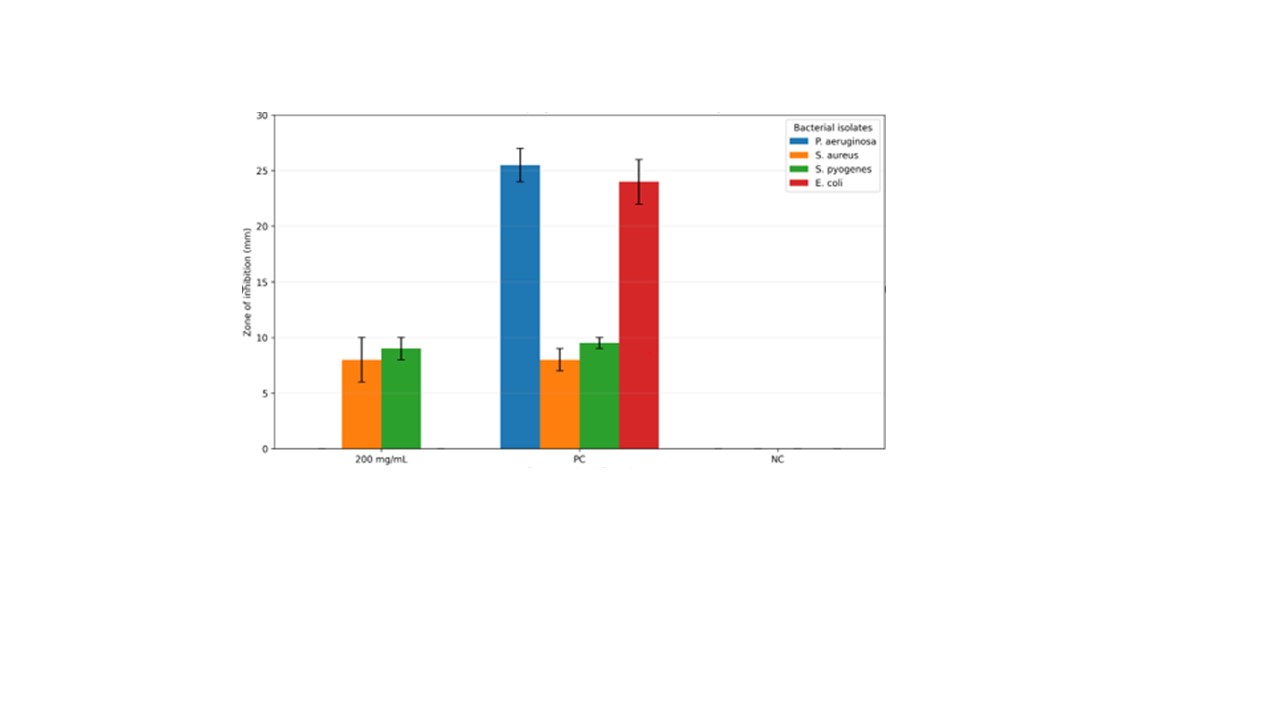
Wound infections remain a major public health concern due to the increasing prevalence of multidrug-resistant bacterial pathogens, which reduce the effectiveness of conventional antibiotics. This study evaluated the antibacterial activity of Achatina fulica shell powder against selected bacterial pathogens associated with wound infections. Shells of A. fulica were cleaned, dried, pulverized, and suspended in absolute ethanol to prepare a stock concentration of 200 mg/mL. The antibacterial activity of the shell powder was evaluated against Staphylococcus aureus, Streptococcus pyogenes, Pseudomonas aeruginosa, and Escherichia coli using the agar disc diffusion method. The minimum inhibitory concentration (MIC) and minimum bactericidal concentration (MBC) were determined using the broth tube dilution method. Achatina fulica shell powder exhibited antibacterial activity against the Gram-positive bacteria S. aureus and S. pyogenes, with mean inhibition zones of 8.00 ± 2.00 mm and 9.00 ± 1.00 mm, respectively. No antibacterial activity was observed against P. aeruginosa or E. coli. The MIC for both susceptible isolates was 200 mg/mL, while no MBC was detected within the concentration range tested. Achatina fulica shell powder possesses selective but modest antibacterial activity against Gram-positive wound pathogens and demonstrates bacteriostatic properties at relatively high concentrations. Therefore, further studies are needed to investigate in-vivo antibacterial activity.
References
Abdul-Khaliq, S. H., Chachain, N. F., & Abdurazaq, R. A. (2020). Investigating the Effect of Lymnaea auricularia (snail) Powder on Different Species of Pathogenic Bacteria. Medico-legal Update, July-September 2020, 20(3) 634 – 639.
Akilimali, B. U., Solomon, B. M., &Shombo,D.A. (2025). Detection of Antibiotic Residues in Powders of Bivalve and Gastropod Mollusc Shells at the Laboratory of the University Clinics of Lubumbashi Using the Disk Diffusion Method. Ophthalmol Res, 8(6), 1-5.
Ali, R. E., Zayed, K. M., Hamed, A. A., Habib, M. R., Abu ElEinin, H. A., Ghareeb, M. A., & Gad El-Karim, R. M. (2024). Bioactive potential and chemical characterization of Planaxissulcatus (Phylum: Mollusca, Family: Planaxidae) solvent extracts. Advances in Traditional Medicine, 24(3), 859-870.
Alogna, A., Liboni, A., & Rizzo, R. (2025). Evaluation of Biological Properties and Beneficial Effects for a Sustainable and Conscious Exploitation of Achatina fulica Snails. Biology, 14(2), 190. https://doi.org/10.3390/biology14020190
Attah, F., Abalaka. M, Adobu, U. S. & Oludare, T. T. (2021). In-vitro Investigation on the Therapeutic Potential of Carica papaya Leaf Extract on Some Pathogenic Bacteria. South Asian Research Journal of Natural Products, 4(1), 9-15.
Baquero, F., Rodríguez-Beltrán, J., & Levin, B. R. (2024). Bacteriostatic cells instead of bacteriostatic antibiotics? MBio, 15(2), e02680-23.
Breijyeh, Z., Jubeh, B., & Karaman, R. (2020). Resistance of gram-negative bacteria to current antibacterial agents and approaches to resolve it. Molecules, 25(6), 1340.
Giftson, H., & Patterson, J. (2014). Antibacterial activity of the shell extracts of marine mollusc Donax faba against pathogens. Int J. Microbiol. Res., 5(2), 140- 143.
Maher, C., & Hassan, K. A. (2023). The Gram-negative permeability barrier: tipping the balance of the in and the out. MBio, 14(6), e01205-23.
Malone, M., Bjarnsholt, T., McBain, A. J., James, G. A., Stoodley, P., Leaper, D., ... & Wolcott, R. D. (2017). The prevalence of biofilms in chronic wounds: a systematic review and meta-analysis of published data. Journal of wound care, 26(1), 20-25.
Murray, C. J., Ikuta, K. S., Sharara, F., Swetschinski, L., Aguilar, G. R., Gray, A., ... & Tasak, N. (2022). Global burden of bacterial antimicrobial resistance in 2019: a systematic analysis. The lancet, 399(10325), 629-655.
Musa, F. M., Haruna, N. F. G., Nuhu, A. M., Ibrahim, B., & Abdulkadir, S. (2022). Antimicrobial Activity of Mitracarpusscaber Leaf Extract against Some Human Pathogenic Microorganisms. African Scientist, 22(1), 23-30.
Nyangono, N.M., Soppo, L.V., Lekeuke, C., Ngo, N.N.S.R., Benga, M.F.C., Nko’o M.H., Macauley, N.D, Mpondo, M.E, & Nnanga, N. (2021). Healing and antibacterial activity of the powder and shell extracts of Achatina fulica Bowdich (Achatinidae) detected in vitro and in ovo. International Journal of Current Research in Chemistry and Pharmaceutical Sciences, 8(6), 27–41.
Senthilkumar, M., Ramachandran, S. K., Servarayan, K. L., Periyasamy, A., Sivasamy, V. V., & Sundaram, E. (2024). Isolation of chitosan and hydroxyapatite from waste edible white garden snail shells and their sensing applications. International Journal of Biological Macromolecules, 275, 133483. https://-doi.org/10.1016/j.ijbiomac.2024.133483
Uberoi, A., McCready-Vangi, A., & Grice, E. A. (2024). The wound microbiota: microbial mechanisms of impaired wound healing and infection. Nature Reviews Microbiology, 22(8), 507-521.
Voleti, A. V. (2022). Anti-Bacterial Activity of Ricinus Communis Extracts against Common Human Pathogens Obtained from Surgical Wound Infections in a Tertiary Care Hospital of Semi-urban Set Up at Andhra Pradesh, India. Journal Of Clinical and Diagnostic Research.16(2), 1-4. DOI: 10.7860/JCDR/2022/51310.1-5970
Wang, C., Shirzaei Sani, E., Shih, C.-D., Lim, C. T., Wang, J., Armstrong, D. G., & Gao, W. (2024). Wound management materials and technologies from bench to bedside and beyond. Nature Reviews Materials, 9, 550 – 566.
Wiegand, I., Hilpert, K., & Hancock, R. E. (2008). Agar and broth dilution methods to determine the minimal inhibitory concentration (MIC) of antimicrobial substances. Nature protocols, 3(2), 163-175.
World Health Organization. (2024). Global report on infection prevention and control 2024. World Health Organization.
Younas, K., Gul, H., Zaidi, S. S. F., Khan, S. U., Ullah, I., Mulk, S., Hidayat, S., Mahmood, J, M. & Habib, F. (2025). Phytochemical Screening and Antimicrobial Activity of Medicinal Plants: A Comparative Study. The Research of Medical Science Review, 3(12), 501-522.
Downloads
Published
How to Cite
Issue
Section
License

This work is licensed under a Creative Commons Attribution-NonCommercial-ShareAlike 4.0 International License.
Unless a different licence is clearly indicated for a particular article, articles published in the journal are made available under the Creative Commons Attribution 4.0 International (CC BY 4.0) licence. This licence permits others to read, download, copy, distribute, share, adapt, and build upon the published work, including for commercial purposes, provided that appropriate credit is given to the original author(s), the article is properly cited, and any changes made to the original work are clearly indicated.