
Assessment of Well Log Correlation and Petrophysical Characterization of D1 Reservoir Sands in the OKW Field, Southeastern Niger Delta, Nigeria
DOI:
https://doi.org/10.83080/rejost.vol6no6.313Keywords:
Reservoir characterization, Formation evaluation, Clastic Reservoirs, Hydrocarbon saturation, OKW Field, Niger Delta Basin, Reservoir quality, Well-log interpretationAbstract
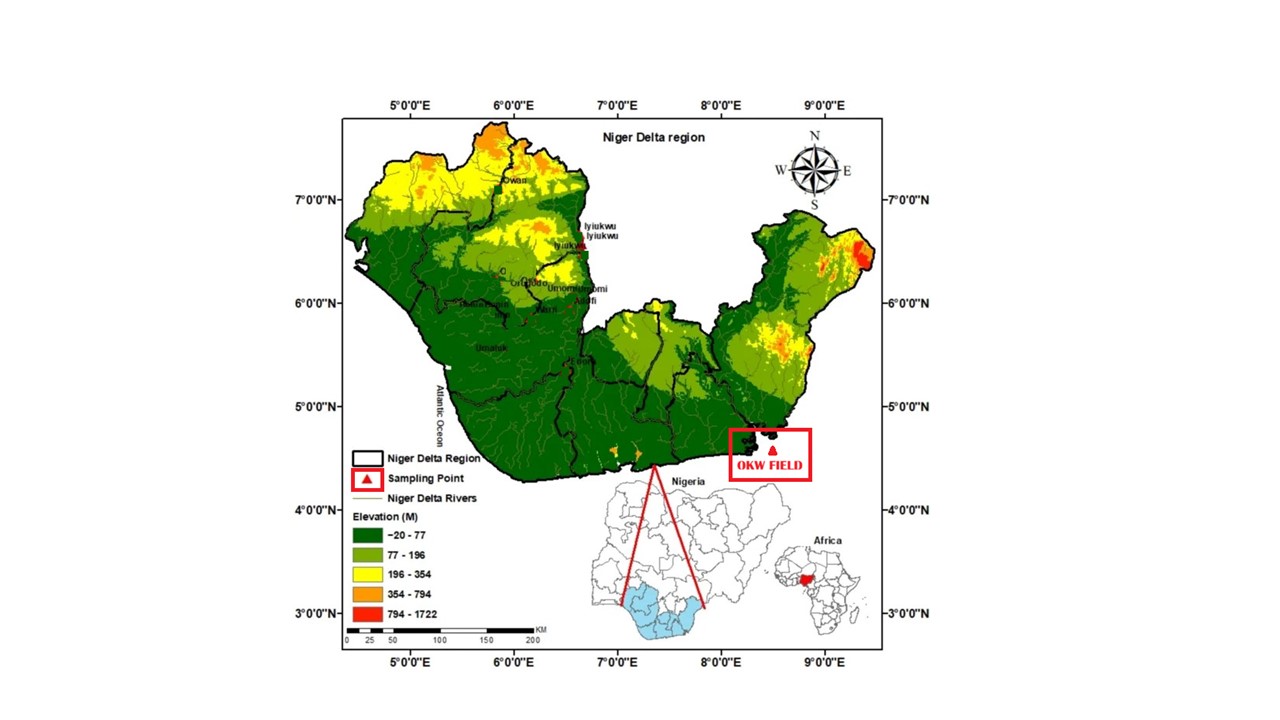
Accurate reservoir characterization is fundamental to reserve estimation, hydrocarbon recovery optimization, and field development planning in clastic petroleum systems. This study presents an integrated well-log correlation and petrophysical evaluation of the D1 reservoir interval within the OKW Field, offshore southeastern Niger Delta, Nigeria, with the objective of assessing reservoir continuity, reservoir quality, and hydrocarbon potential. Wireline log data comprising gamma-ray, resistivity, neutron, density, sonic, and spontaneous potential logs from OKW 1, OKW 7 and OKW 10 were interpreted using a combination of stratigraphic correlation, neutron-density cross-plot analysis, and quantitative petrophysical evaluation. Gamma-ray correlation established the lateral continuity of the D1 sandstone unit across the field, confirming a regionally extensive reservoir package within the upper Agbada Formation. Cross-plot analysis successfully discriminated shale, brine-bearing sands, and hydrocarbon-bearing sands, thereby improving lithological and fluid characterization. Petrophysical results reveal significant variability in reservoir quality among the studied wells. OKW 1 exhibits a gross reservoir thickness of 210.70 ft, net-to-gross ratio of 0.97, effective porosity of 32%, permeability of 1,874.46 mD, water saturation of 36%, hydrocarbon saturation of 64%, and net pay thickness of 45 ft. OKW 7 records the highest effective porosity (37%) and permeability (3,651.06 mD), but its high water saturation (76%) and low hydrocarbon saturation (24%) indicate a predominantly water-bearing reservoir. OKW 10 represents the most prospective interval, with a gross thickness of 235.53 ft, effective porosity of 36%, permeability of 3,622 mD, low water saturation of 20%, hydrocarbon saturation of 80%, bulk volume water of 0.07, and net pay thickness of 137.61 ft. Comparative reservoir ranking indicates that OKW 10 possesses the most favorable combination of reservoir quality and hydrocarbon charge, followed by OKW 1, whereas OKW 7 is limited primarily by excessive water saturation despite excellent rock properties. The results demonstrate that hydrocarbon prospectivity within the D1 reservoir is controlled not only by porosity and permeability but also by fluid distribution and structural compartmentalization. This study provides the first integrated multi-well assessment of the D1 reservoir interval in OKW Field and establishes a quantitative framework for reservoir appraisal and future field development in offshore Niger Delta sandstone reservoirs.
References
Abraham, A. B., Evans, A. B., & Thompson, B. E. (2019). Analysis of spatial distribution pattern of reservoir petrophysical properties for horizontal well performance evaluation: A case study of Reservoir X. The Open Petroleum Engineering Journal. 4(2), 189 – 199.
Akindulureni, J. O., Adepelumi, A. A., & Benjamin, U. K. (2018). Evolution, geometry and formative processes of depositional elements in Niger Delta slope settings. Universal Journal of Geoscience, 6(4), 118–129. https://doi.org/10.13189-/ujg.2018.060403
Anyiam, U. O., & Uzuegbu, E. (2020). 3D seismic attribute-assisted stratigraphic framework and depositional setting characterization of frontier Miocene to Pliocene aged Agbada Formation reservoirs, deep offshore Niger Delta Basin. Marine and Petroleum Geology.
Asuaiko, E. R., Bassey, C. E., Harry, T. A., Owoeye, T. A., & Ibanga, V. E. (2022). Source Rock Evaluation of Shale in Parts of Ini Local Government Area, Akwa Ibom State, Southeastern Niger Delta Basin, Nigeria. European Journal of Environment and Earth Sciences, 3 (2) 89 – 94. http://dx.doi.org/10.24018/ejgeo- /2022.3.2.279
Asuaiko, E. R., Bassey, C. E., Harry, T. A., & Ekpo, A. E. (2024). Thermal Maturity and Hydrocarbon Generation Potential of Shales: A case study of Parts of Ini, Akwa Ibom State, Southeastern Niger Delta Basin, Nigeria. Researchers Journal of Science and Technology, 4 (4): 50 -67. DOI: https://doi.org/10.83080/rejost.vol4no4.130
Doust, H. (1989). The Niger Delta: Hydrocarbon potential of a major Tertiary delta province. In W. J. M. van der Linden, S. A. P. L. Cloetingh, J. P. K. Kaasschieter, W. J. E. van de Graaff, J. Vandenberghe, & J. A. M. van der Gun (Eds.), Coastal Lowlands (pp. 203–212). Springer. https://doi.org/10.1007/978-94-017-1064-0_13.
Doust, H., & Omatsola, E. (1990). Niger Delta. In J. D. Edwards & P. A. Santogrossi (Eds.), Divergent/Passive Margin Basins (AAPG Memoir 48, pp. 239–248). American Association of Petroleum Geologists
El-Bagoury, M. (2020). Integrated petrophysical study to validate water saturation from well logs in Bahariya Shaley Sand Reservoirs, case study from Abu Gharadig Basin, Egypt. Journal of Petroleum Exploration and Production Technology, 10, 3139–3155. https://doi.org/10.1007-/s13202-020-00969-3
Essien, N. U., Okon, E. E. (2017). Sedimentary processes and depositional environments of part of the Benin Formation in the Calabar Flank, Southeastern Nigeria. British Journal of Applied Science & Technology, 95 - 105
Evamy, B. D., Haremboure, J., & Kame, P. (1978). Hydrocarbon habitat of Tertiary Niger Delta. AAPG Bulletin.
Fazli Khani, H., & Back, S. (2012). Temporal and lateral variation in the development of growth faults and growth strata in western Niger Delta, Nigeria. AAPG Bulletin.
Gomaa, S., Soliman, A. A., Mohamed, A., Emara, R., & Attia, A. M. (2022). New correlation for calculating water saturation based on permeability, porosity, and resistivity index in reservoirs. ACS Omega.
Harry, T. A., Etim, C. E., & Okechukwu, A. E. (2022). Petrophysical evaluation of H-field, Niger Delta Basin for petroleum plays and prospects. Materials and Geoenvironment, 69 (2), DOI: 10.2-478/rmzmag-2021-0020. Pg. 1-11
Harry, T. A, Bassey, C. E., Petters, S. W. (2017) Sequence Stratigraphy and Biostrati-graphic Characterization of System Tracts in the Calabar Flank: International Journal of Scientific & Engineering Research; 8(7), 1787-1798.
Harry, T. A., Etim I. U., Etim, C. E. (2022); Sedimentology and Palynology Models of Sedimentary Sections along Lemna Section of the Benin Formation, Cross River-Southern Nigeria: Pakistan Journal of Geology (PJG), 6 (1), 24-28.
Harry, T. A., Bassey, C. E., Udofia, P. A., & Daniel, S. (2017). Baseline study of estuarine oceanographic effects on benthic foraminifera in Qua Iboe, Eastern Obolo, and Uta Ewa/Opobo River Estuaries, Southeastern Nigeria. International Journal of Scientific and Engineering Research, 8(7), 1422–1331.
Harry, T. A., Etuk, S. E., Joseph, I. N., & Austin, O. E. (2018). Geomechanical evaluation of reservoirs in the coastal swamp, Niger Delta Region, Nigeria. International Journal of Advanced Geosciences, 6(2), 165–172.
Harry, T. A., & Akata, N. I. (2019). Evaluation of shale volume and effective porosity from wireline logs in “Watty” Field, Niger Delta, Nigeria. International Journal of Scientific & Engineering Research, 10(12), 1150–1158.
Kouadio, K. E., Abrakasa, S., Ikiensikimama, S. S., & Botwe, T. (2020). Source rocks characterization of Agbada and Akata Formations in the Niger Delta, Nigeria. European Journal of Environment and Earth Sciences, 1(4), 89 - 95
Reijers, T. J. A. (2011). Stratigraphy and sedimentology of the Niger Delta. Geologos, 17(3), 133 – 162. https://-doi.org/10.2478/v10118-011-000-8-3.
Short, K. C., & Stable, A. J. (1967). Outline of geology of Niger Delta. American Association of Petroleum Geologists Bulletin, 51(5), 761–799. https://doi.org-/10.1306/5D25C0CF-16C-1-11D7-8645000102C1865D
Su, Y., Wang, T., Tang, L., Zhang, X., Zhang, B., Wang, X., Li, Y., & Chen, Z. (2019). The sedimentary and tectonic features of the Niger Delta. Acta Petrologica Sinica, 35(4), 1126 – 1136. https://doi.org/-10.18654/1000-0569/2019.04.17
Telford, W. M., Geldart, L. P., & Sheriff, R. E. (1990). Applied geophysics (2nd ed.). Cambridge University Press. Pg.1123-1130, ISBN 978-0-521-33938-4.
Tuttle, M. L. W., Charpentier, R. R., & Brownfield, M. E. (1999). The Niger Delta petroleum system: geologic analysis and resource assessment. 3(1) 128-134
Downloads
Published
How to Cite
Issue
Section
License
Copyright (c) 2026 Researchers Journal of Science and Technology

This work is licensed under a Creative Commons Attribution-NonCommercial-NoDerivatives 4.0 International License.
Unless a different licence is clearly indicated for a particular article, articles published in the journal are made available under the Creative Commons Attribution 4.0 International (CC BY 4.0) licence. This licence permits others to read, download, copy, distribute, share, adapt, and build upon the published work, including for commercial purposes, provided that appropriate credit is given to the original author(s), the article is properly cited, and any changes made to the original work are clearly indicated.