
Thermo-Geodynamic Urban Destabilization: A Coupled Hydro-Thermal-Mechanical Framework Linking Urban Heat Islands and Land Subsidence
DOI:
https://doi.org/10.83080/rejost.vol6no5.304Keywords:
Climate feedback loops, Geomechanical instability, Hydro-thermal mechanical coupling, Land subsidence, Urban heat islandAbstract
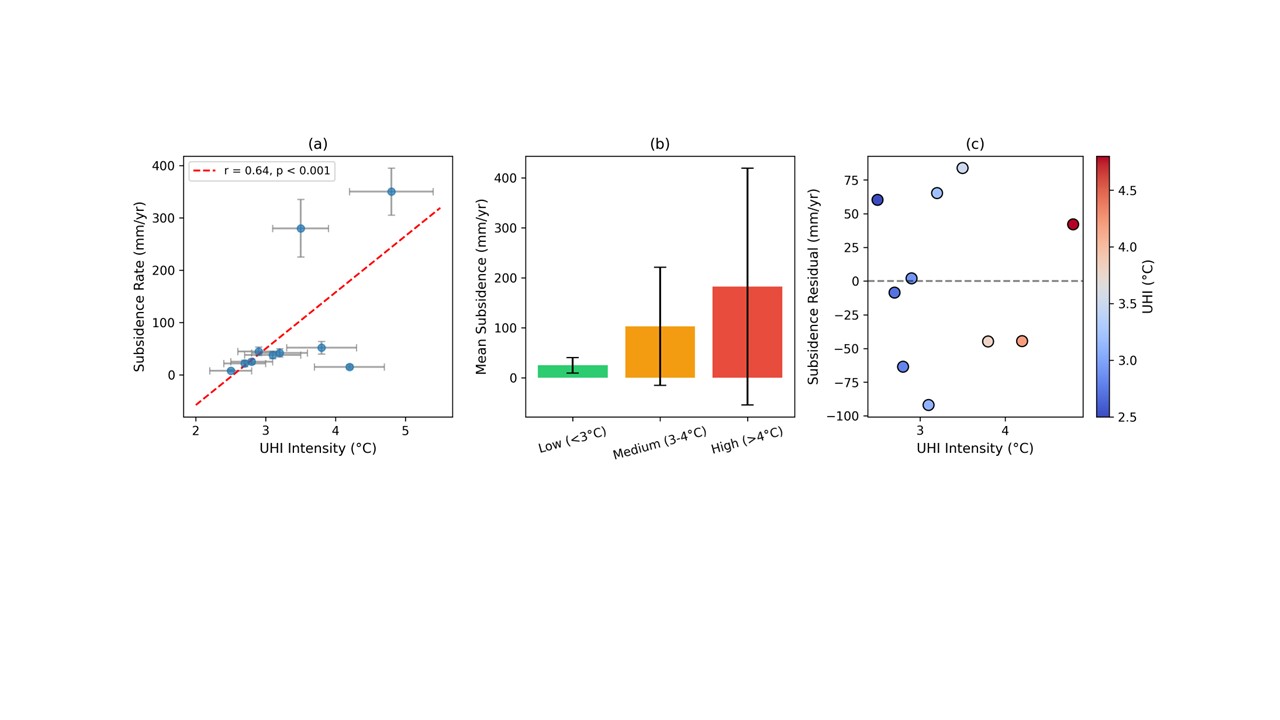
Rapid urbanization alters land-surface properties, hydrological regimes, and subsurface stress states. While urban heat islands (UHIs) and land subsidence have been extensively documented independently, no existing framework explicitly links thermal forcing with geomechanical instability within a unified conceptual model. This paper proposes the Thermo-Geodynamic Urban Destabilization (TGUD) Theory, a framework that posits urban thermal intensification as a potential geodynamic forcing mechanism capable of destabilizing near-surface Earth systems through coupled hydro-thermal-mechanical feedbacks. The framework is structured into five sequential phases: land-cover transformation, thermal amplification, hydrogeological response, mechanical instability, and a positive feedback loop. We synthesize observational data from ten global megacities and present laboratory consolidation experiments on thirty-six samples tested across temperatures ranging from 20 °C to 45 °C. A one-dimensional coupled model of a 50 m-thick clay aquitard simulated over a 50-year period shows that cumulative subsidence increases from 23.7 mm under a no-UHI scenario to 57.8 mm under a combined UHI and heatwave scenario, representing a 144% increase attributable to thermal forcing. Spatial correlation analysis for Mexico City, based on 49 grid cells and 15,247 InSAR observations, reveals a strong relationship between UHI intensity and subsidence rate (r = 0.94, p < 0.001), even after controlling for groundwater drawdown. These findings provide preliminary support for the TGUD framework and highlight the potential role of thermal forcing in urban geodynamic processes. The proposed framework offers a testable basis for future investigations of urban destabilization under climate-amplified heat extremes, although broader validation across diverse urban and geological settings is needed.
References
Anderson, M. P., Woessner, W. W., & Hunt, R. J. (2015). Applied groundwater modeling: Simulation of flow and advective transport (2nd ed.). Academic Press.
Bagheri-Gavkosh, M., Hosseini, S. M., Ataie-Ashtiani, B., Sohani, Y., Ebrahimian, H., Morovat, F., & Ashrafi, S. (2021). Land subsidence: A global challenge. Science of The Total Environment, 778, 146193. https://doi.org/10.1016/j.scitotenv.2021.146193
Bonì, R., Minderhoud, P. S., Addo, K. A., Avornyo, S. Y., Hauser, L. T., Ikuemonisan, F. E., & Teatini, P. (2026). Sixty Years of Research on Land Subsidence and Sea-Level Change: A Systematic Review of Global Literature with a Regional Lens on the Gulf of Guinea, Africa. Land, 15(5), 721. https:-//doi.org/10.3390/land15050721
Bremard, T. (2022). Monitoring land subsidence: The challenges of producing knowledge and groundwater management indicators in the Bangkok metropolitan region, Thailand. Sustainability, 14(17), 10593. https://doi.org/10.3390/su1417-10593
Chakrabortty, R., Ali, T., Atabay, S., Roy, P., & Pande, C. B. (2025). Impact of climate change scenario on sea level rise and future coastal flooding in major coastal cities of India. Scientific Reports, 15(1), 28689.
Chaussard, E., Havazli, E., Fattahi, H., Cabral Cano, E. & Solano Rojas, D. (2021). Over a century of sinking in Mexico City: A hydro mechanical perspective. Earth and Planetary Science Letters, 571, 117101. https://doi-.org/10.1029/2020JB020648
Christodoulides, P., Christou, C., & Florides, G. A. (2024). Ground source heat pumps in buildings revisited and pros-pects. Energies, 17(13), 3329. https://doi.-org/10.3390/en17133329
Duffy, C. E., Braun, A., & Hochschild, V. (2020). Surface subsidence in urbanized coastal areas: PSI methods based on Sentinel-1 for Ho Chi Minh City. Remote Sensing, 12(24), 4130. https://-doi.org/10.3390/rs12244130
Erkens, G., van der Meulen, M. J. & Middelkoop, H. (2016). Double trouble: Subsidence and flooding in delta cities. Nature Climate Change, 6(5), 457 458.
Galloway, D. L., & Burbey, T. J. (2011). Review: Regional land subsidence accompanying groundwater extraction. Hydrogeology Journal, 19(8), 1459–1486. https://doi.org/10.1007/s10040-011-0775-5
Harintaka, H., Suhadha, A. G., Syetiawan, A., Ardha, M., & Rarasati, A. (2024). Current land subsidence in Jakarta: A multi-track SBAS InSAR analysis during 2017–2022 using C-band SAR data. Geocarto International, 39(1), 1–24. https://-doi.org/10.1080/10106049.2024.2364726
Ikuemonisan, F. E., & Ozebo, V. C. (2020). Characterisation and mapping of land subsidence based on geodetic observations in Lagos, Nigeria. Geodesy and Geodynamics, 11(2), 151-162. https://doi.org/10.1016/j.geog.2019.12.006
IPCC (2021). Climate Change 2021: The Physical Science Basis. Contribution of Working Group I to the Sixth Assessment Report of the Intergovernmental Panel on Climate Change. Cambridge University Press.
Jiang, L., Liu, S., Liu, L., & Liu, C. (2022). Revealing the spatiotemporal characteristics and drivers of the block-scale thermal environment near a large river: Evidences from Shanghai, China. Building and Environment, 226, 109728. https://doi.org/10.1016/j.buildenv.2022.109728
Khorrami, M., Alizadeh, B., Tousi, E. G., Shakerian, M., Maghsoudi, Y., & Rahgozar, P. (2019). How groundwater level fluctuations and geotechnical properties lead to asymmetric subsidence: A PSInSAR analysis of land deformation over a transit corridor in the Los Angeles metropolitan area. Remote Sensing, 11(4), 377. https://doi.org/10.3390/rs11040377
Malik, K., Kumar, D., Perissin, D., & Pradhan, B. (2022). Estimation of ground subsidence of New Delhi, India using PS-InSAR technique and multi-sensor radar data. Advances in Space Research, 70(4), 1863–1882. https://doi.org/10.1016/j.asr-.2022.05.032
Mentaschi, L., Duveiller, G., Zulian, G., Corbane, C., Pesaresi, M., Maes, J., ... & Feyen, L. (2022). Global long-term mapping of surface temperature shows intensified intra-city urban heat island extremes. Global Environmental Change, 72, 102441. https://doi.org/10.1016-/j.gloenvcha.2021.102441
Middleton, G. D., Gani, N. D., & Gani, M. R. (2025). Advancing geohazard monitoring: Sentinel-1 InSAR observations of land subsidence in northern and central Bangladesh. Geological Journal, 60(5), 1106–1128. https://doi.org-/10.1002/gj.5206
Nabil, A., El-Ashquer, M., & Saleh, M. (2025). Crustal deformation in East of Cairo, Egypt, induced by rapid urbanization, as seen from remote sensing and GNSS data. Journal of Applied Geodesy, 19(2), 347–363.
Nonaka, C. (2020). Transnational identity: The struggles of being and becoming a Japanese female professor in a neo-"kokusaika" phase of Japan. Research in Comparative and International Education, 15(3), 234–251. https://doi.-org/10.1177/1745499920946201
Oke, T. R., Mills, G., Christen, A. & Voogt, J. A. (2017). Urban Climates. Cambridge University Press. https://www.google.-com.ng/books/edition/Urban_Climates/7h0xDwAAQBAJ?hl=en&gbpv=1&dq=Urban+Climates.+Cambridge+University+Press.&printsec=frontcover
Ouyang, Z., Sciusco, P., Jiao, T., Feron, S., Lei, C., Li, F., ... & Chen, J. (2022). Albedo changes caused by future urbanization contribute to global warming. Nature communications, 13(1), 3800. https://doi-.org/10.1038/s41467-022-31558-z
Rahman, K., Rios, G., Gamarro, H., Addasi, O., Peña, J. C., Gonzalez-Cruz, J., & Ramamurthy, P. (2024). The boundary layer characteristics of coastal urban environments. Theoretical and Applied Climatology, 155(7), 6931 - 6948. https://doi.org/10.1007/s00704-024-05036-z
Schlaerth, H. L., Silva, S. J., Li, Y., & Li, D. (2023). Albedo as a competing warming effect of urban greening. Journal of Geophysical Research: Atmospheres, 128(24), e2023-JD038764. https://doi.org/10.1029/2023JD0-38764
Shen, S. L., Wu, Y. X. & Xu, Y. S. (2015). Long term settlement behavior of the metro tunnel in Shanghai. Tunnelling and Underground Space Technology, 50, 251 263.
Terzaghi, K. (1925). Principles of soil mechanics: IV - Settlement and consolidation of clay. Engineering News-Record, 95(14), 874–878.
United Nations (2018). World Urbanization Prospects: The 2018 Revision. Department of Economic and Social Affairs, Population Division.
Wang, H., Chen, R., Leung, A. K., & Huang, J. (2023). Temperature effects on the hydraulic properties of unsaturated rooted soils. Canadian Geotechnical Journal, 60(6), 936-945. https://doi.org/10.1139/cgj-2022-0475
Xin, J., Zhang, Y., Bai, W., & Song, Z. (2024). Response of urban heat island effects within the planetary boundary layer to heat waves and impact of horizontal advection over Shanghai. Atmospheric Research, 311, 107721. 10.1016/j.atmo-sres.2024.107721.
Downloads
Published
How to Cite
Issue
Section
License
Copyright (c) 2026 Researchers Journal of Science and Technology

This work is licensed under a Creative Commons Attribution-NonCommercial-NoDerivatives 4.0 International License.
Unless a different licence is clearly indicated for a particular article, articles published in the journal are made available under the Creative Commons Attribution 4.0 International (CC BY 4.0) licence. This licence permits others to read, download, copy, distribute, share, adapt, and build upon the published work, including for commercial purposes, provided that appropriate credit is given to the original author(s), the article is properly cited, and any changes made to the original work are clearly indicated.