Long-Term Trends in Solar Radiation and Climatic Variability Across Nigeria: Implications for Renewable Energy Potential
DOI:
https://doi.org/10.83080/rejost.vol6no4.300Keywords:
Solar radiation, Renewable energy potential, Mann–Kendall trend test, Climate variability, Temperature trends, Relative humidity, Photovoltaic energy, NigeriaAbstract
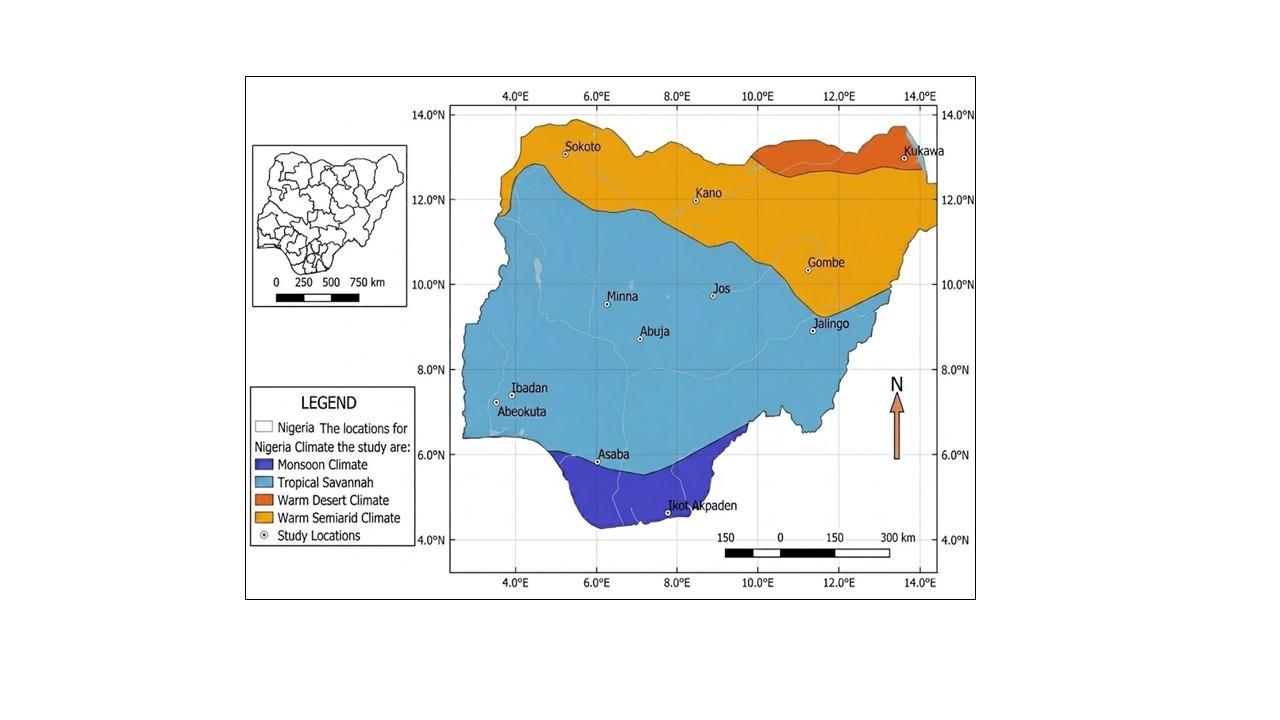
The increasing demand for sustainable energy and the growing impacts of climate change have intensified the need for reliable assessments of solar energy resources across different regions of the country. Despite the abundant solar energy potential in Nigeria, limited studies have comprehensively assessed the combined influence of climatic variability on solar radiation and photovoltaic energy generation. This study examined the long-term trends of solar radiation and climatic variability across Nigeria and evaluated their implications for the country's renewable energy potential across selected climatic zones. Climatic datasets comprising Global Horizontal Irradiance (GHI), temperature, and relative humidity, spanning a total of 45 years (1981‒2025) were obtained from the NASA POWER database for twelve selected locations representing the Warm Desert (Kukawa), Semiarid (Sokoto, Gombe, and Kano), Tropical Savannah (Abeokuta, Abuja, Minna, Jalingo, Jos, and Ibadan), and Monsoon (Ikot Akpaden and Asaba). The study adopted the Mann-Kendall trend test and Sen’s slope estimator to assess long-term trends in solar radiation and climatic variables, while correlation analysis was employed to investigate the relationships between the study parameters. Additionally, a simplified photovoltaic energy estimation model based on a standardized 2kW photovoltaic system capacity was adopted in this study to estimate the solar photovoltaic energy output. The Mann-Kendall trend analysis revealed a statistically significant decreasing trend in solar radiation across all study locations (p < 0.05), with Z-values ranging from -3.404 to -5.425 and Sen’s slope values ranging from -0.005 today. Temperature showed a significant increasing trend in most locations, with Z-values ranging from 2.299 to 5.645 and Sen’s slope values ranging from 0.009 to 0.067 °C/year, indicating increasing regional warming pattern across the study area. Relative humidity revealed a strong spatial variability, with increasing trends observed in Ikot Akpaden, Asaba, Abeokuta, Ibadan, Sokoto, and Kukawa, while Abuja, Minna, and Jalingo revealed decreasing trends. The Z-values ranged from 1.595 to 5.204, while Sen’s slope values ranged from -0.218 to 0.224 %/year. The correlation heat map revealed that solar radiation correlates negatively with relative humidity, with the strongest negative correlations observed in Abeokuta (-0.72), Ibadan (-0.63), Kukawa (-0.54), and Ikot Akpaden (-0.55). The estimated annual photovoltaic energy output ranged from approximately 2450 kWh/year to 3450 kWh/year for the standardized 2kW photovoltaic system, with northern locations such as Kukawa, Kano, Sokoto, and Gombe exhibiting the highest solar energy potential. These findings demonstrate the strong influence of long-term climatic variability on solar energy resources across the country. The study reveals a clear north-south variation in solar energy potential, pointing out the potential of northern Nigeria for solar energy development and provides essential scientific information for renewable energy panning, sustainable energy policy development, and climate adaptation strategies in Nigeria.
References
Agbo, E. P., & Ekpo, C. M. (2021a). Trend analysis of the variations of ambient temperature using Mann-Kendall test and Sen’s estimate in Calabar, southern Nigeria. Journal of Physics: Conference Series, 1734(1), 012016. https://iop-science.iop.org-/article/10.1088/1742-6596/1734/1/012016/meta
Agbo, E. P., Ettah, E. B., & Eno, E. E. (2021b). The impacts of meteorological parameters on the seasonal, monthly, and annual variation of radio refractivity. Indian Journal of Physics, 95(2), 195 –207. https://doi.org/10.1007/s12648-02-0-01711-9.
Agbo, E. P., Nkajoe, U., Okono, M. A., Inyang E. P. & Edet, C. O. (2023). Temperature and solar radiation interactions in all six zones of Nigeria. Indian J Phys 97, 655–669. https://doi.org/10.1007/s12648-02-2-02429-6.
Alhaji, U. U., Yusuf, A. S., Edet, C. O., Oche C. O., & Agbo, E. P. (2018). Trend Analysis of Temperature in Gombe State Using Mann Kendall Trend Test. Journal of Scientific Research & Reports 20(3): 1 - 9, Article no. JSRR.42029 ISSN: 2320-0227.
Ashraf, M. A., Yang, M., Zhang, Y., Denden, M., Tlili, A., Liu, J., & Burgos, D. (2021). A systematic review of systematic reviews on blended learning: Trends, gaps and future directions. Psychology research and behavior management, 1525 - 1541. https://-doi.org/10.2147/PRBM.S331741
Ayanlade, A., Atai, G., & Jegede, M. O. (2019). Spatial and seasonal variations in atmospheric aerosols over Nigeria: Assessment of influence of intertropical discontinuity movement. Journal of Ocean and Climate, 9, 1759313-118820306. https://doi.org/10.1177/175-9313118820306
Calma, J., & Fajardo, S. M. (2025). Climate Trend Analysis Using Mann-Kendall and Sen’s Slope Estimator Tests in Central Luzon, Philippines. Interdisciplinary Research Re-view, 20(1). retrieved from, https://ph02.-tcithaijo.org/-index.php/jtir/article/view/-250008.
Ekanem, A. M., George, N. J., Thomas, J. E. & Udo, I. G. (2024). Geophysical investigation of aquifer flow unit characteristics in northern parts of Akwa Ibom State, Southern Nigeria. Results in Earth Sciences, 2, 100017, ISSN 2211-7148, https://-doi.org/10.1016/j.rines.20-24.100017
Falayi, E. O. (2013). The impact of cloud cover, relative humidity, temperature and rainfall on solar radiation in Nigeria. energy and power, 3(6), 119-127. https://doi.org/10.5923/j.ep.20130306.03.
George, N.J., Bassey, N.E., Ekanem, A.M.& Thomas, J. E. (2020). Effects of anisotropic changes on the conductivity of sedimentary aquifers, southeastern Niger Delta, Nigeria. Acta Geophys. 68, 1833–1843 (2020). https://doi.org/-10.1007/s11600-020-00502-4
George, N.J., Ekanem, A.M., Thomas, J.E. & Harry, T. A. (2022a). Modelling the effect of geo-matrix conduction on the bulk and pore water resistivity in hydrogeological sedimentary beddings. Model. Earth Syst. Environ. 8, 1335–1349 (2022). https://doi.org/-10.1007/s40808-021-01161-0
George, N.J., Umoh, J.A., Ekanem, A.M., Ogbasi, O. E., Jamel, A. & Thomas, J. E. (2022b). Geophysical-laboratory data integration for estimation of groundwater volumetric reserve of a coastal hinterland through optimized interpolation of interconnected geo-pore architecture. J Coast Conserv., 26, 56. https://doi.org/10.1007/s11852-022-00902-2
Hatzianastassiou, N., Ioannidis, E., Korras-Carraca, M. B., Gavrouzou, M., Papadimas, C. D., Matsoukas, C., & Vardavas, I. (2020). Global dimming and brightening features during the first decade of the 21st century. Atmosphere, 11(3), 308; https://doi.org/10.3390-/atmos11030308.
Liu, S., Xing, J., Zhao, B., Wang, J., Wang, S., Zhang, X., & Ding, A. (2019). Understanding of aerosol–climate interactions in China: Aerosol impacts on solar radiation, temperature, cloud, and precipitation and its changes under future climate and emission scenarios. Current Pollution Reports, 5(2), 36 - 51. https://doi.org/10.1007/s40726-019-00-107-6.
Merem, E. C., Twumasi, Y., Wesley, J., Isokpehi, P., Shenge, M., Fageir, S., & Nwagboso, E. (2017). Assessing the ecological effects of mining in West Africa: The case of Nigeria. International Journal of Mining Engineering and Mineral Processing, 6(1), 1-19, https://doi.org/10.5923/j.mining.20170-601.01.
Mohammed, Y. S., Mustafa, M. W. N., Bashir, N., & Mokhtar, A. S. (2013). Renewable energy resources for distributed power generation in Nigeria: A review of the potential. Renewable and Sustainable Energy Reviews, 22, 257-268, ISSN 1364-0321; https://doi.org/10.1016/j.rs-er.2013.01.020.
Ohunakin, O. S., Adaramola, M. S., Oyewola, O. M., Matthew, O. J., & Fagbenle, R. O. (2015). The effect of climate change on solar radiation in Nigeria. Solar Energy, 116, 272-286. https://doi.org/-10.1016/j.solener.2015.03.027.
Okono, M. A., Agbo, E. P., Ekah, B. J., Ekah, U. J., Ettah, E. B., & Edet, C. O. (2022). Statistical analysis and distribution of global solar radiation and temperature over southern Nigeria. Journal of the Nigerian Society of Physical Sciences, 4(3), 588. https://doi.org/10.46481/jnsp-s.2022.588.
Rhodes, C. J. (2010). Solar energy: principles and possibilities. Science progress, 93(1), 37- 112, https://doi.org/10.3184/003685010X12626410325
Singh, J., & Kumar, M. (2016). Solar radiation over four cities of India: Trend analysis using Mann-Kendall Test. International Journal of Renewable Energy Resources, 6, 1385-1395.
Stern, D. I. (2019). Energy and economic growth. In Routledge handbook of Energy economics (pp. 28-46). Routledge.
Udosen, N. I., Ekanem, A. M. & George, N. J. (2024a). Geophysical exploration to assess leachate percolation and aquifer protectivity within hydrogeological units at a major open dump in Eket, Nigeria, Results in Earth Sciences, 2, 100022, ISSN 2211-7148, https://doi.org/10.10-16/j.rines.2024.100022.
Udosen, N. I., Ekanem, A. M., & Thomas, J. E. (2024b). Geo-hydraulic characterization of a coastal aquifer system in South-eastern Nigeria with the inverse slope method. Researchers Journal of Science and Technology, 4(1), 1–20. https://doi-.org/10.83080/rejost.vol4no1.82
Udosen, N.I., Ekanem, A.M., George, N.J. (2024c). Modeling of aquifer geo-hydraulic characteristics with geo-electrical methods at a major coastal aquifer system in Uyo, southern Nigeria. Water Practice and Technology, 19 (2): 611–628. https://doi.org/10.2166/wpt.2-024.018
Wild, M., Folini, D., Henschel, F., Fischer, N., & Müller, B. (2015). Projections of long-term changes in solar radiation based on CMIP5 climate models and their influence on energy yields of photovoltaic systems. Solar Energy, 116, 12-24, ISSN0038-092X, https://doi.org/10.1016/j.solener.2015.03.039, https://www.sciencedirect-.com/scie-nce/article/pii/S0038092X15001668.
Downloads
Published
How to Cite
Issue
Section
License
Copyright (c) 2026 Researchers Journal of Science and Technology

This work is licensed under a Creative Commons Attribution-NonCommercial-NoDerivatives 4.0 International License.
Unless a different licence is clearly indicated for a particular article, articles published in the journal are made available under the Creative Commons Attribution 4.0 International (CC BY 4.0) licence. This licence permits others to read, download, copy, distribute, share, adapt, and build upon the published work, including for commercial purposes, provided that appropriate credit is given to the original author(s), the article is properly cited, and any changes made to the original work are clearly indicated.