Effects of Zinc Oxide Nanoparticle Spiking on Physicochemical Parameters and Substrate-Induced Respiration in Ultisols
DOI:
https://doi.org/10.83080/rejost.vol6no3.274Keywords:
Ultisol,, Zinc oxide nanoparticles, Engineered nanoparticles, Substrate-induced respiration (SIR)Abstract
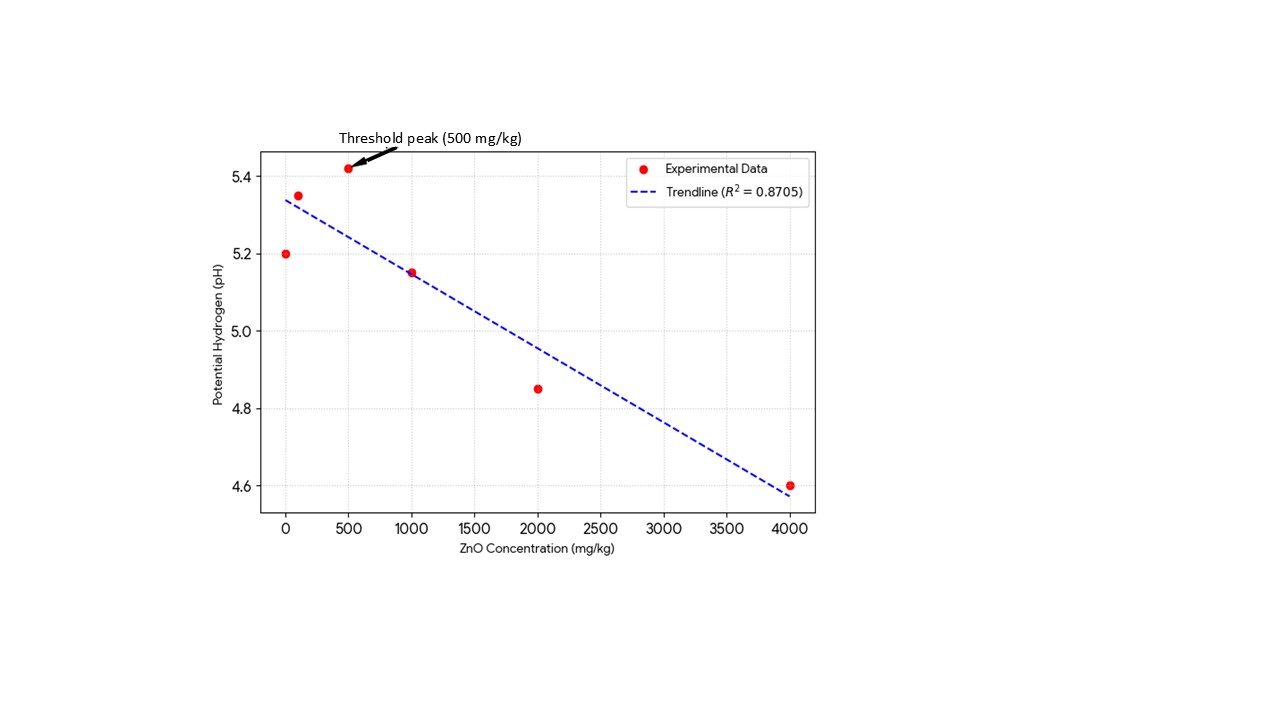
This study investigates the concentration-dependent effects of zinc oxide nanoparticles (ZnO-NPs) on soil physicochemical properties and substrate-induced respiration in ultisols. The ZnO-NPs were synthesized via the chemical precipitation method using zinc sulfate and potassium hydroxide precursors. Characterization using X-ray Diffraction confirmed a highly crystalline hexagonal wurtzite structure, while Scanning Electron Microscopy and Transmission Electron Microscopy revealed predominantly spherical morphology with an average particle size of 20 nm. Soil samples were collected from a depth of 0–20 cm and treated with varying concentrations of ZnO-NPs (0, 100, 500, 1000, 2000, and 4000 mg kg⁻¹). Soil pH was determined potentiometrically in a 1:2.5 soil-water suspension, and moisture content was measured gravimetrically after oven-drying at 105°C. Exchangeable cations (Ca and Mg) were extracted using ammonium acetate, while anions (SO₄²⁻, NO₃⁻, and PO₄³⁻) and Total Organic Carbon were analyzed using standard spectrophotometric and Walkley-Black wet oxidation methods, respectively. Microbial activity was quantified via the alkali absorption method, measuring the soil respiration rate as µg CO₂ g⁻¹ soil h⁻¹ during a 7 day incubation period. The results demonstrated a clear biphasic (hormetic) response. At low to moderate doses (100–500 mg kg⁻¹), ZnO-NPs acted as a biostimulant, peaking at 500 mg kg⁻¹ with significant increases in pH (5.42), moisture content (20.1%), NO₃⁻ (22.1 mg kg⁻¹), and respiration rate (52.3 µg CO₂ g⁻¹ soil h⁻¹). However, concentrations exceeding 1000 mg kg⁻¹ induced severe inhibitory effects. At 4000 mg kg⁻¹, the soil experienced significant acidification (pH 4.60) and reduced moisture-holding capacity (14.8%). Statistical analysis confirmed that differences between treatments were significant at p <0.05. These findings suggest that while ZnO-NPs can improve the physicochemical and biological status of acidic ultisols at controlled doses, high accumulation triggers nanotoxicity and soil degradation.
References
Ayisha, N. & Kiruthika, R. (2025). Nanotechnology in Modern Agriculture: A Mini Review. Archived of Food & Nutritional Science, 9(1), 020-023.
Anindita, D.& Papiya N. (2024). Size, Shape, and Dose-three Crucial Determinants for Applying Nanoparticles in Sustainable Plant Biology. Academia Biology, 2 (3),7331-7342.
APHA (1998). Standard Methods for Examination of Water & Waste Water. 20th edition, Washington, D.C: American Public Health Association, 28-40 pp.
Bates, R. G. (1954). Revised Standard Values for pH Measurement from 0 to 95C. Journal of Research of the National Bureau of Standards, (22): 179-196.
Eduok, S., Robert F., R., Jefferson, B., Villa, R. & Coulon, F. (2017) Aged Engineered Nanoparticles Effect on Sludge Anaerobic Digestion Performance & Associated Microbial Communities. Science of the Total Environment,609: 232–241.
Chen, J., Dou, R., Yang, Z., You, T., Gao, X. &Wang, L.(2018). Phytotoxicity & Bioaccumulation of Zinc Oxide Nanoparticles in Rice (Oryza sativa L.). Plant Physiology and Biochemistry, 130(10), 604–612.
Das, B. K., Verma, S. K., Das, T., Panda, P. K., Parashar, K., Suar, M. & Parashar, S. K. (2018). Altered Electrical Properties with Controlled Copper Doping in ZnO Nanoparticles Infers their Cytotoxicity in Macrophages by ROS Induction & Apoptosis. Chemistry & Biology Interaction, 297, 141–154.
Dimkpa, O. C. (2020). Soil Properties Influence the Response of Terrestrial Plants to Metallic 2Nanoparticles Exposure. International Fertilizer Development Center (IFDC), 46 David Lilienthal Dr., Muscle 6 Shoals, Alabama, 35661 USA. 391p
Emmanuel O. O. (2023). Comparative Studies of Biosynthesized Zinc Oxide Nanoparticles. Nanochemistry Research, 8(1), 31-39.
Hongda, S., Qingqing, P., Jiao, G. & Haoyue, Z. (2022). Effects of Short-term Soil Exposure of Different Doses of ZnO Nanoparticles on the Soil Environment & the Growth and Nitrogen Fixation of alfalfa. Environmental Pollution, 309, 119817.
Jegan, R., Pankaj, S. C., Atheek, U. R., Harish, S., Devendra, B. S., Neeraj & Reddypriya, P. (2025). Applications of Nanotechnology in Agriculture: A Review. Journal of Advances in Biology and Biotechnology, 28 (2), 877-895.
Jośko, P., Oleszczuk, P. & Skwarek, E. (2017). Toxicity of Combined Mixtures of Nanoparticles to Plants. Journal of Harzadous Materials, 331, 200-209.
Karam, A. E., Haija, Y. W. &Rafael, M. S. (2024). Onsite Determination of Soil Organic Carbon Content: A Photocatalytic Approach. Clean Technologies, 6(2), 784-801.
Rana, L., Kumar, M., Rajput, J., Kumar, N., Sow, S., Kumar, S., Kumar, A., Singh, S. N., Jha, C. K., Singh, A. K. & Ranjan, S. (2024) Nexus Between Nanotechnology & Agricultural Production Systems: Challenges and Future Prospects. Discover Applied Sciences, 6(11), 1–9.
Tripathi, G., Gupta, V. &Joshi, R. (2025). Transforming Agriculture through Nanotechnology: A Comprehensive Overview. Madras Agricultural Journal, 1(3), 111-116.
USDA- NRCS United States Department of Agriculture- Natural Resources Conservation Service (2019). Soil Testing Procedures; National Soil Survey Handbook, 430: pp. 15-30
Wang, X., Li. X., Dou, F., Sun, W., Wen, Y.& Ma, X. (2021). Elucidating the Impact of three Metallic Nano agrichemicals & their Bulk Ionic Counterparts on the Chemical Properties of Bulk and Rhizosphere Soils in Rice Paddies. Environmental Pollution, 290, 118005.
Xue, W., Huang, D., Zeng, G., Wan, J., Zhang, C., Xu, R., Cheng, M. & Deng, R. (2018). Nanoscale Zero-valent IronCoatedwithRhamnolipidasanEffectiveStabilizerforImmobilizationofCdandPbinRiverSediments. Journal of Hazardous Materials, 341,381–389.
Zhao, S., Su, X., Wang, Y., Yang, X., Bi, M., He, Q. & Chen, Y. (2020). Copper Oxide Nanoparticles Inhibited Denitrifying Enzymes and Electron Transport System Activities to Influence Soil Denitrification & N2O Emission. Chemosphere, 245(9), 125-310.
Downloads
Published
How to Cite
Issue
Section
License
Copyright (c) 2026 Researchers Journal of Science and Technology

This work is licensed under a Creative Commons Attribution-NonCommercial-NoDerivatives 4.0 International License.
Unless a different licence is clearly indicated for a particular article, articles published in the journal are made available under the Creative Commons Attribution 4.0 International (CC BY 4.0) licence. This licence permits others to read, download, copy, distribute, share, adapt, and build upon the published work, including for commercial purposes, provided that appropriate credit is given to the original author(s), the article is properly cited, and any changes made to the original work are clearly indicated.