A Computational Analysis of Lexical and Form-Level Variation between the Lutenga and Lupakoyo Varieties of Lusoga
DOI:
https://doi.org/10.83080/rejost.vol6no10.366Keywords:
Lusoga, Lutenga, Lupakoyo, Lexical variation, Character-level analysis, Correspondence consistencyAbstract
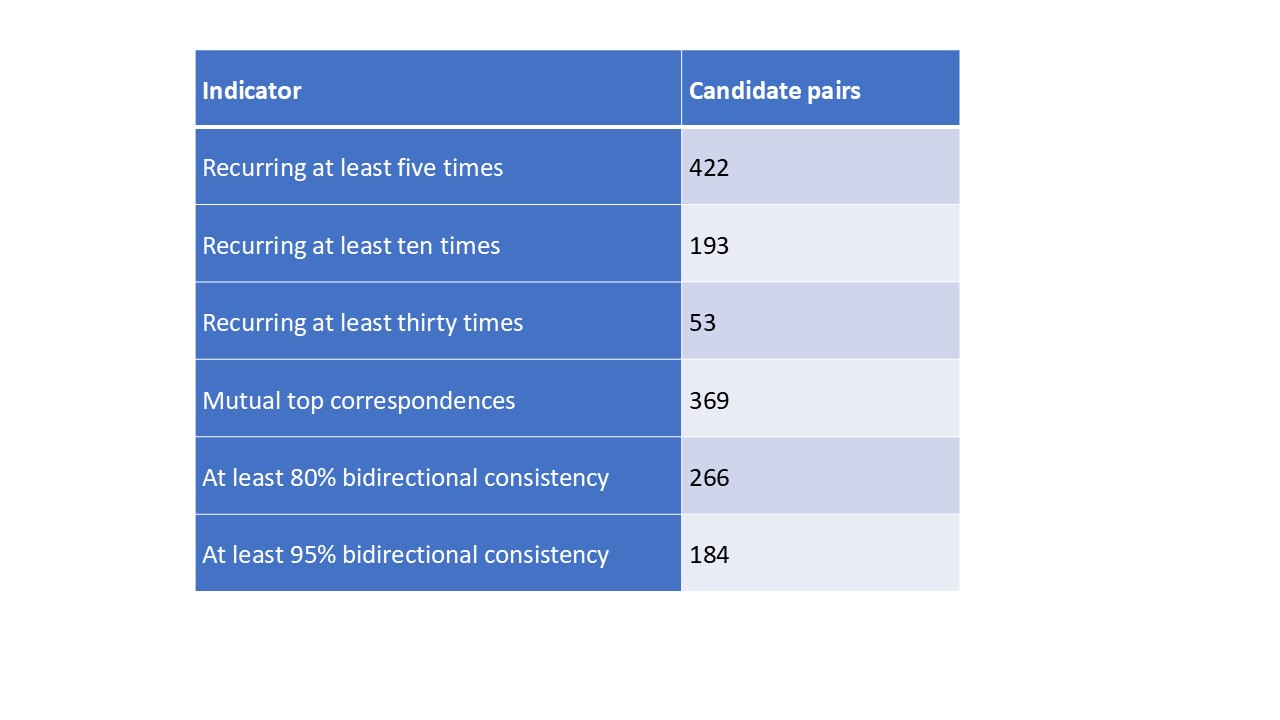
Differences between closely related language varieties are not always apparent from general measures of similarity, particularly when they involve alternative words or recurring changes in written forms. This study examined lexical and written-form variation between Lutenga and Lupakoyo, two regional varieties of Lusoga spoken in eastern Uganda. Using 14,597 aligned English–Lutenga–Lupakoyo sentence triplets, the analysis combined sequence-based word alignment, character-similarity analysis, character-edit analysis, contextual screening, and bidirectional correspondence-consistency measures. It identified 5,644 distinct candidate word-form correspondences, of which 422 occurred at least five times. Among these recurrent pairs, 41 had character-similarity scores below 0.40. Examination of the corresponding translation contexts suggested that eight of these pairs could represent alternative lexical choices, although their linguistic status was not independently established. Most extracted correspondences (75.6%) involved closely resembling written forms, although this resemblance does not necessarily imply a shared linguistic structure. The analysis also identified 52 character-edit families. Insertion of o was the most frequent, occurring 2,699 times across ten distinct word pairs, whereas deletion of g occurred 526 times across 31 pairs. This difference illustrates how a transformation may occur frequently without being widely distributed across word forms. Of the 422 recurrent correspondences, 369 (87.4%) were mutual top counterparts, while 266 (63.0%) achieved at least 80% bidirectional consistency.These measures indicate recurring and relatively consistent associations within the extracted inventory, but do not independently establish that the correspondences represent systematic linguistic differences between the two varieties. The study provides a corpus-based account of these associations, offering a basis for investigating lexical differentiation and written-form variation, and for identifying patterns that warrant further linguistic validation.
References
Bloom Ström, E.-M., & Petzell, M. (2025). Micro-variation approaches to Bantu language varieties. In L. Marten, E. Hurst-Harosh, N. C. Kula, & J. Zeller (Eds.), The Oxford guide to the Bantu languages (pp. 423–432). Oxford University Press. https://doi.org/10.1093/oso/9780198808343.003.0033
Creissels, D. (2025). Typology and variation. In L. Marten, E. Hurst-Harosh, N. C. Kula, & J. Zeller (Eds.), The Oxford Guide to the Bantu Languages (pp. 28–42). Oxford University Press. https://doi.org/10.1093-/oso/9780198808343.003.0004
de Schryver, G.-M., & Nabirye, M. (2018). Corpus-driven Bantu lexicography part 1: Organic corpus building for Lusoga. Lexikos, 28, 32–78. https://doi.org/-10.5788/28-1-1457
de Schryver, G.-M., & Nabirye, M. (2022). Towards a monitor corpus for a Bantu language: A case study of neology detection in Lusoga. In A. Klosa-Kückelhaus, S. Engelberg, C. Möhrs, & P. Storjohann (Eds.), Dictionaries and society: Proceedings of the 20th EURALEX International Congress (pp. 833–849). IDS-Verlag. https://doi.org/10.14618/-phpy-6r66
Edelsten, P., Guérois, R., & Marten, L. (2024). Comparative analysis of morphosyntactic variation in Bantu languages: Parameters, data representation, and design. In E.-M. Bloom Ström, H. Gibson, R. Guérois, & L. Marten (Eds.), Morphosyntactic variation in Bantu (pp. 25–52). Oxford University Press. https://doi.org/10.1093/oso/-9780198821359.003.0002
Faisal, F., Ahia, O., Srivastava, A., Ahuja, K., Chiang, D., Tsvetkov, Y., & Anastasopoulos, A. (2024). DialectBench: A NLP benchmark for dialects, varieties, and closely related languages. Proceedings of the 62nd Annual Meeting of the Association for Computational Linguistics (Volume 1:
Long Papers), 14412–14454. https://doi.org/10.18653/v1/2024.acl-long.777
Hopton, Z. W., & Aepli, N. (2024). Modeling orthographic variation in Occitan’s dialects. Proceedings of the Eleventh Workshop on NLP for Similar Languages, Varieties, and Dialects (VarDial 2024), 78–88. https://doi.org/10.18653/v1/-2024.vardial-1.6
Isiko, A. P. (2018). Gender roles in traditional healing practices in Busoga [Doctoral dissertation, Leiden University]. http://hdl.handle.net/1887/63215
Joshi, A., Dabre, R., Kanojia, D., Li, Z., Zhan, H., Haffari, G., & Dippold, D. (2025). Natural language processing for dialects of a language: A survey. ACM Computing Surveys, 57(6), Article 149, 1–37. https://doi.org/10.1145/3712060
Kasonde, A. (2025). The long march to Unicode: A digital approach to variability in Icibemba orthography. Cogent Arts & Humanities, 12(1), 2477347. https://doi.org/10.1080/23311983.2025.2477347
Kimera, R., Rim, D. N., & Choi, H. (2022). Building a parallel corpus and training translation models between Luganda and English. Journal of KIISE, 49(11), 1009–1016. https://doi.org/10.5626/jok.2022.4-9.11.1009
Kumar, S., Anastasopoulos, A., Wintner, S., & Tsvetkov, Y. (2021). Machine translation into low-resource language varieties. Proceedings of the 59th Annual Meeting of the Association for Computational Linguistics and the 11th International Joint Conference on Natural Language Processing (Volume 2: Short Papers), 110–121. https://doi.org/10.18653/v1/2021.acl-short.16
Kuparinen, O., & Scherrer, Y. (2024). Corpus-based dialectometry with topic models. Journal of Linguistic Geography, 12(1), 1–12. https://doi.org/10.1017/jlg.2024.6
Lin, P., Scholman, M., Saeed, M., & Demberg, V. (2024). Modeling orthographic variation improves NLP performance for Nigerian Pidgin. Proceedings of the 2024 Joint International Conference on Computational Linguistics, Language Resources and Evaluation (LREC-COLING 2024), 11510–11522. https://aclanthology.org/2024.lrec-main.1006/
Min, J., Tan, T., & Malancon, B. (2024). Hybrid distance-statistical-based phrase alignment for analyzing parallel texts in standard Malay and Malay dialects. Malaysian Journal of Computer Science, 37(1), 1–25. https://doi.org/10.22452/mjcs.vol37no1.1
Nabirye, M. (2016). A corpus-based grammar of Lusoga [Doctoral dissertation, Ghent University]. http://hdl.handle.net/1854/-LU-8125501
Nabirye, M., de Schryver, G.-M., & Verhoeven, J. (2016). Lusoga (Lutenga). Journal of the International Phonetic Association, 46(2), 219–228. https://doi.org/10.1017/S0025-100315000249
Python Software Foundation. (n.d.). difflib — Helpers for computing deltas. Retrieved November 7, 2026, from https://-docs.python.org/3.13/library/difflib.html
Shadrova, A. (2025). No three productions alike: Lexical variability, situated dynamics, and path dependence in task-based corpora. Open Linguistics, 11(1), Article 20240036. https://doi.org/10.1515/opli-2024-0036
Shim, R. S., & Plank, B. (2025). Dialetto, ma quanto dialetto? Transcribing and evaluating dialects on a continuum. Findings of the Association for Computational Linguistics: NAACL 2025, 838–849. https://doi.org/10.18653/v1/-2025.findings-naacl.48
Wang, G., & Xin, Y. (2024). An analytical framework for corpus-based translation studies. Humanities and Social Sciences Communications, 11(1), 1709. https://doi.org/10.1057/s41599-024-04250-4
Xie, R., Ahia, O., Tsvetkov, Y., & Anastasopoulos, A. (2024). Extracting lexical features from dialects via interpretable dialect classifiers. Proceedings of the 2024 Conference of the North American Chapter of the Association for Computational Linguistics: Human Language Technologies (Volume 2: Short Papers), 54–69. https://doi.org/10.18653/-v1/2024.naacl-short.5
Downloads
Published
How to Cite
Issue
Section
License

This work is licensed under a Creative Commons Attribution-NonCommercial-ShareAlike 4.0 International License.
Unless a different licence is clearly indicated for a particular article, articles published in the journal are made available under the Creative Commons Attribution 4.0 International (CC BY 4.0) licence. This licence permits others to read, download, copy, distribute, share, adapt, and build upon the published work, including for commercial purposes, provided that appropriate credit is given to the original author(s), the article is properly cited, and any changes made to the original work are clearly indicated.