Development of an Optimized Predictive Machine Learning Approach for Smart Irrigation System using Cuckoo Search Algorithm
DOI:
https://doi.org/10.83080/rejost.vol6no2.272Keywords:
Smart irrigation System, Water Quality Prediction, Machine Learning, Cuckoo Search Algorithm, Hyperparameter optimization, Precision AgricultureAbstract
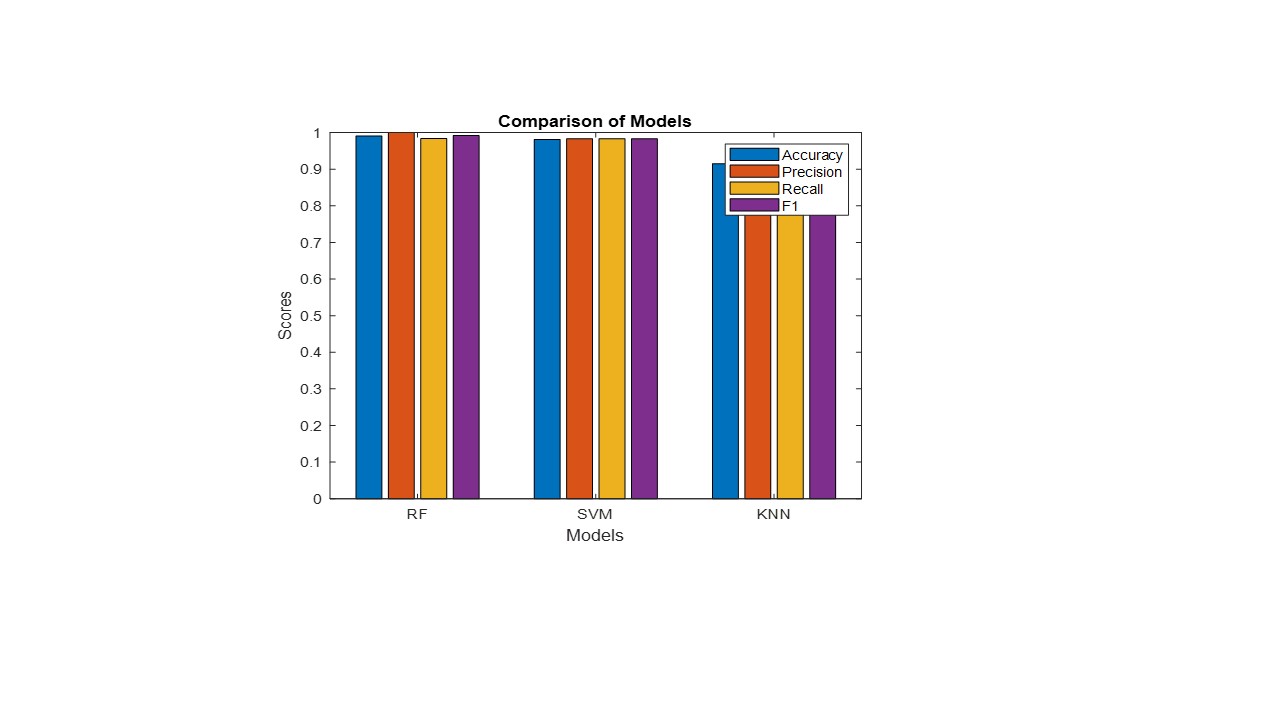
The increasing global demand for water conservation has necessitated the development of intelligent irrigation systems. However, traditional irrigation systems often lack efficiency, leading to significant water waste. This study proposes an optimized predictive machine learning approach for smart irrigation system using Cuckoo Search Algorithm (CSA) that can be used to optimized irrigation scheduling and reduce water usage while maintaining crop yield. The system involves data collection, pre-processing, model training and optimization, WaterNet dataset is used with parameters like temperature, pH, turbidity and coliforms. The CSA is employed to optimize the hyperparameters of three machine learning model: Random Forest (RF) 99.07%, Support Vector Machine (SVM) 98.36% and K-Nearest Neighbors (KNN) 89.6%. The Optimized Random Forest (ORF) achieves exceptional performance, significantly improving prediction accuracy. CSA optimization was performed using different population sizes specifically n = 5, n = 10 and n = 20, larger populations yielded better behavior but required more iterations for convergence. In terms of convergence curve, CSA has fast convergence with fewer iterations (16) while PSO has slower convergence and more iterations (25 to 49), the difference is the time they took to converge, additionally, CSA-RF outperforms multilayer perceptron (MLP), due to hyperparameter tuning. Comparison between actual values (Ytest) with predictions from two models; Random Forest (Ypred.RF) shows deviations and misclassifications from actual value while optimized model (Ypred.optimized) predictions matched the actual values. The comparative analysis of classification methods highlights the superiority of the proposed ORF, which was fine-tuned using the CSA. The performance metrics which are accuracy, precision, recall, and F1-score achieved an exceptional score, demonstrating the robustness of the proposed approach, the ORF not only achieved excellent performance levels but also incorporated hyperparameter tuning, ensuring improved stability and reduced risk of overfitting. This study contributes to the development of efficient and sustainable smart irrigation systems, supporting precision agriculture and water conservation efforts.
References
Abbasnia, A., Yousefi, N., Farsani, M. M. & Mahvi, A. H. (2018). Human and Ecological Risk Assessment ( An Internat-ional Evaluation of groundwater quality using water quality index and its suitability for assessing water for drinking and irrigation purposes :Case study of Sistan and Baluchistan province (Iran ), Hum. Ecol.Risk Assess. 0 (0): 1–18, doi: 10.1080/10807039.2018.1458596.
Ajayi, O. O., Bagula, A. B., Maluleke, H. C., Gaffoor, Z., Jovanovic, N. & Pietersen, K. C. (2022). WaterNet: A Network for Monitoring and Assessing Water Quality for Drinking and Irrigation Purposes, IEEE Access, (10): 48318–48337 doi: 10.1109/ACCESS2022317-2274.
Al-Shourbaji, I. & Duraibi, S. (2023). IWQP4Net: An Efficient Convolution Neural Network for Irrigation Water Quality Prediction, Water (Switzerland), 15 (9) doi: 10.3390/w15091657.
Badrun B., & M. Manaf. (2021). The Development of Smart Irrigation System with IoT, Cloud, and Big Data, IOP Conf. Ser. Earth Environ. Sci., 830 (1), doi: 10.1088/1755-1315/830/1/012009.
Bortolini, L., Maucieri, C. & M. Borin. (2018). A tool for the evaluation of irrigation water quality in the arid and semi-arid regions, Agronomy, 8 (2): 1–15, doi: 10.3390/agronomy8020023.
Chen, H., Chen, A., Xu, L., Xie, H., Qiao, H., Lin, Q. and Cai, K. (2020). A deep learning CNN architecture applied in smart near-infrared analysis of water pollution for agricultural irrigation resources, Agric. Water Manag., 240: 106303 doi: 10.1016/j.agwat.2020106303.
Dassanayake, D., Dassanayake, K., Malano, H., Dunn, G. M., Douglas, P. & Langford, J. (2009). Water saving through smarter irrigation in Australian dairy farming: Use of intelligent irrigation controller and wireless sensor network.
El Bilali, A. & Taleb, A. (2020): Prediction of irrigation water quality parameters using machine learning models in a semi-arid environment,” J. Saudi Soc. Agric. Sci., 19 (7): 439–451, doi: 10.1016/j.jssas.2020.08.001.
Fanadzo, M. & Ncube, B. (2018). Challenges and opportunities for revitalising small holder irrigation schemes in South Africa, Water SA, 44 (3): 436–447, doi: 10.4314/wsa.v44i3.11.
Gamal, Y., Soltan, A., Said, L., Madian, H. and Radwan, A. (2023). Smart Irrigation Systems: Overview,” IEEE Access, 1–1 doi: 10.1109/ACCESS.20-23.3251655.
Hossein, A. & Yang, G. X (2013). Cuckoo search algorithm : A metaheuristic approach to solve structural optimization problems, 17–35, doi: 10.1007/s00366-011-0241-y.
Ilić, M., Srdjević, Z. & Srdjević, B. (2022). Water quality prediction based on Naïve Bayes algorithm,” Water Sci. Technol., 85 (4): 1027–1039 doi: 10.2166/wst2022006.
Katimbo, A., Rudnick D. R., Zhang J., Ge, Y., Dejonge K. C., Franz, T. E., Shi, Y., Liang, W. & Qiao, X. (2023). Evaluation of artificial intelligence algorithms with sensor data assimilation in estimating crop evapotranspiration and crop water stress index for irrigation water management,
Smart Agric. Technol., 4 (2022): 100176 doi: 10.1016/j.atech.2-023100176.
Mohammed, M. A. A., Kaya, F., Mohamed, A., Alarifi S. S., Abdelrady, A. & Keshavarzl. (2023). Application of GIS-based machine learning algorithms for prediction of irrigational groundwater quality indices,” Front. Earth Sci., 11: 1–19, doi: 10.3389/feart.20231-274142.
Mokhtar, A., Elbeltagi, A., Gyasi-Agyei, Y., Al-Ansari, N. & Abdel-Fattah, M. K (2022) Prediction of irrigation water quality indices based on machine learning and regression models, Appl. Water Sci. 12 (4): 1–14, doi: 10.1007/s13201-022-01590-x.
Najah Ahmed, A., Binti Othman, F., Afan H. A., Ibrahim, R. K., Fal, M. C., Hossain, M. S., Ehteram M. & Elshafie A. (2019). Machine learning methods for better water quality prediction J. Hydrol. 578, doi: 10.1016/j.jhydrol-.124084.
Singh, S., Ghosh, N. C., S., Gurjar, G., Krishan, S., Kumar, & Berwal P. (2018). Index-based assessment of suitability of water quality for irrigation purpose under Indian conditions, Environ. Monit. Assess., 190 (1) doi: 10.1007/s10661-017-6407-3.
Ungureanu, N., Vlăduț, V., & Voicu, G. (2020). Water scarcity and wastewater reuse in crop irrigation,” Sustain., 12 (21): 1–19, doi: 10.3390/su12219055.
Yadav, R. K., Jha, A. and Choudhary. (2021). IoT based prediction of water quality index for farm irrigation, Proc. - Int. Conf. Artif. Intell. Smart Syst. ICAIS 1443–1448, doi: 10.1109/ICAIS5093-0.20219395921.
Yang, X., Deb, S. & Behaviour, A. C. B. (2009). Cuckoo Search via L´evy Flights, 210–214.
Younesa, A., Elamrani, Z., Elassada, A., El Meslouhia, O., Abou, D.E. & Majida, E. A. (2023): The application of machine learning techniques for Smart Irrigation Systems : a systematic literature review Abstract : Introduction : Preprint, not peer-reviewed
Downloads
Published
How to Cite
Issue
Section
License
Copyright (c) 2026 Researchers Journal of Science and Technology

This work is licensed under a Creative Commons Attribution-NonCommercial-NoDerivatives 4.0 International License.
Unless a different licence is clearly indicated for a particular article, articles published in the journal are made available under the Creative Commons Attribution 4.0 International (CC BY 4.0) licence. This licence permits others to read, download, copy, distribute, share, adapt, and build upon the published work, including for commercial purposes, provided that appropriate credit is given to the original author(s), the article is properly cited, and any changes made to the original work are clearly indicated.