
Landslide Susceptibility Assessment using Geotechnical Index Properties of Soils in Ibam Edet and Odorokpe Villages, Ini LGA, Akwa Ibom State, Nigeria
DOI:
https://doi.org/10.83080/rejost.vol6no2.266Keywords:
Landslide Susceptibility, Geotechnical Index Properties, Water saturation, Shear strength, Slope stabilityAbstract
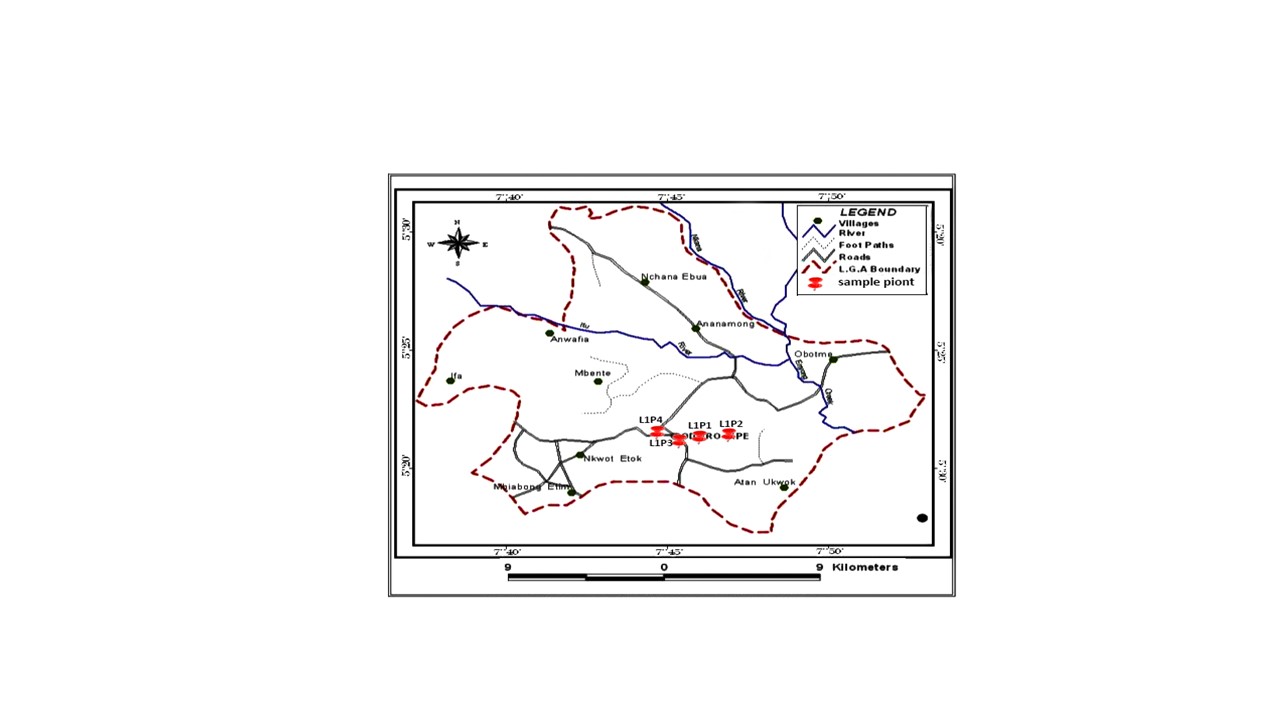
Susceptibility assessment of a landslide was carried out using the geotechnical index properties of soils in Ibam Edet and Odorokpe villages Ini LGA of Akwa Ibom State. The aim was to identify, characterize and evaluate the index properties of the soils in order to assess the susceptibility of the soils to a landslide. Soil samples were retrieved from three locations in Ibam Edet and one location in Odorokpe village using a hand auger from the ground surface to 4.0m depth. The samples were analysed in the laboratory to determine their index properties such as moisture content, Atterberg limits and particle size distributions. The stratigraphy consists of fine-medium grained clayey sand from 0-2m underlain by a medium-coarse grained sand from 2-4m depth in locations L1 and L2. In location L3, a fine-grained sand occurred from 0-4m. While in location L4 a fine-medium grained silty sand occurred from 0-2m underlain by a medium-coarse grained sand from 2-4m. The average moisture content percentages across locations L2 (37.3%), L3 (34.5%) and L4 (39.7%) showed a general decline in water content with depth. While the liquid limit percentages increased with depth in locations L1 (29.6%) and L2 (26.5%). The presence of clays and silts in the sands between 0-2m in locations L1, L2 and L4 will limit the flow of water through the soil as shown in the higher percentages of moisture content and Atterberg limits in the clayey sand and silty sand layers. The particle size distribution plots of the sands show poorly /uniformly graded fine, medium to coarse grained sands that are free draining because of their high porosity and lack of cohesion. An increased water saturation within the pores of the clayey sand and silty sands during prolonged and heavy rainfall reduces the friction and shear strength of the soil which may lead to landslides. This study therefore recommends the drilling and collection of soil samples at depths greater than 4m. Also, an analysis of the soils shear strength to evaluate the angle of internal friction of the clays and sands in order to quantitatively determine the slope stability, estimate the factor of safety and ascertain the degree of susceptibility of the soils to a landslide is recommended.
References
Abija, F. A, Nwosu, J. I, Ifedotun, A. I. & Osadebe, C. C. 2020. Landslide suscep-tibility of Calabar, Nigeria using Geo-technical, Remote sensing and Multi-criteria Decision Analysis: Implications for Urban planning and Development. Journal of Earth Sciences and Environmental studies, Vol. 4, No. 3, Pp. 774-788.
Akpan, A. E, Ekwok, S. E & Ebong, D. E. (2016). Seasonal reversals in groundwater flow direction and its role in the recurrent Agwagune Landslide problem: a geophysical and geological approach. Environmental Earth Science, Vol 75. No. 429, Pp. 1-17.
Aigbadon, G. O, Ocheli, A. & Akudo, E. O. (2021). Geotechnical evaluation of gully erosion and landslides materials and their impact in Iguosa and its environs. Southern Nigeria. Environmental Systems Research, Vol. 10. No. 36, Pp. 1-17.
Ayodele, O. S, Olayanju, G. M. & Adeosun, O. E. (2020). Geological Assessment of Landslide occurrences in Okemesi Area, Southwestern Nigeria. American Journal of Environmental Engineering. Vol. 10. No. 1, Pp. 13-19.
Effiong, J., Eni, D. I, Obiefuna, J. N. & Etu, S. J. (2021). Geospatial modelling of Landslide susceptibility in Cross River State of Nigeria. Scientific Africana. Vol. 14. Pp. 1-14.
Egboka, B. C, Orji, A. E. & Nwankwoala, H. O. (2019). Gully Erosion and Landslides in South eastern Nigeria: Causes, Consequences and Control measures. Global Journal of Engineering Sciences. Vol. 2 No. 4. Pp. 1-11.
Ekanem, E. M. (1994). Urban Sedimentation problems in the Humid tropical city of Uyo. Ibom Journal of Social Science Uyo. Faculty of Social Sciences. Vol. 1. No.2. Pp 8-17.
Ibanga, M. (2021). Geophysical investigation of Landslide occurrence in Northern Akwa Ibom state. Unpublished B.Sc. Thesis. Department of Geology, Akwa Ibom state University. Pp 1-33.
Igwe, C. & Una, C. (2019). Landslide impacts and management in Nanka area, South east Nigeria. Geo environmental Disasters (science Direct). Pp 1-12.
Kim, M. S, Onda, Y, Uchida, T, Kim, J. k (2016). Effects of soil depth and subsurface flow along the subsurface topography on shallow landslide predictions at the site of a small granitic hillslope. Geomorphology (Science Direct). Vol. 271. Pp. 40-54.
Ogbonnaya, I, Brooks, A. E, Maduka, R. I and Oha, I. A. (2015). Landslide Investigation of Ikwette, Obudu Local Government Area of Cross River State, Nigeria. IOSR Journal of Applied Geology and Geophysics (IOSR-JAGG). Vol. 3, No.3. Pp 1-12.
Okogbue, C. O. (1994). Classification and distribution of recent landslides in Southern Nigeria. Engineering Geology. Vol. 37. No. 3-4, Pp. 263-270.
Okogbue, C. O. (2003). A landslide in a quasi-stable slope. Engineering Geology. Vol. 25, No. 1. Pp 69-82.
Reyment, R. A. (1965). Aspects of Geology of Nigeria. University of Ibadan Press. P. 145.
Short, K. C and Stauble, A. J. (1967). Outline of the Geology of the Niger Delta. American Association of Petroleum Geologists. Vol. 56. Pp. 761-799.
Situmorang, H, Nurhasan, N, Rusdiana, R, Virdi, S and Fitriani, D (2022). Subsurface Structure Analysis of Landslide Potential Areas Based on Electrical and Physical properties of soil. Journal of Physics: Conference Series 2377 012044.
Udo-Inyang, U. C. & Edem, I. D. (2012). Analysis of rainfall trends in Akwa Ibom State. Journal of Environment and Earth Science. Vol. 2. No.8, Pp 60-70.
Udosen, C., Etok, A. & Essien, A. (2014). Predictive Analysis of Landslide Susceptibility with GIS-DEMs in Uyo, South Eastern Nigeria. Journal of Geology and Geomatics Engineering. Vol.1 Pp 42-50.
Downloads
Published
How to Cite
Issue
Section
License
Copyright (c) 2026 Researchers Journal of Science and Technology

This work is licensed under a Creative Commons Attribution-NonCommercial-NoDerivatives 4.0 International License.
Unless a different licence is clearly indicated for a particular article, articles published in the journal are made available under the Creative Commons Attribution 4.0 International (CC BY 4.0) licence. This licence permits others to read, download, copy, distribute, share, adapt, and build upon the published work, including for commercial purposes, provided that appropriate credit is given to the original author(s), the article is properly cited, and any changes made to the original work are clearly indicated.