The Effect of Partial Substitution of Feldspar with Palm Bunch Ash on the Mechanical and Electrical Properties of Porcelain Insulator Production
DOI:
https://doi.org/10.83080/rejost.vol5no8.237Keywords:
Palm Bunch Ash, Feldspar replacement, Porcelain ceramics, Dielectric strength, Circular economyAbstract
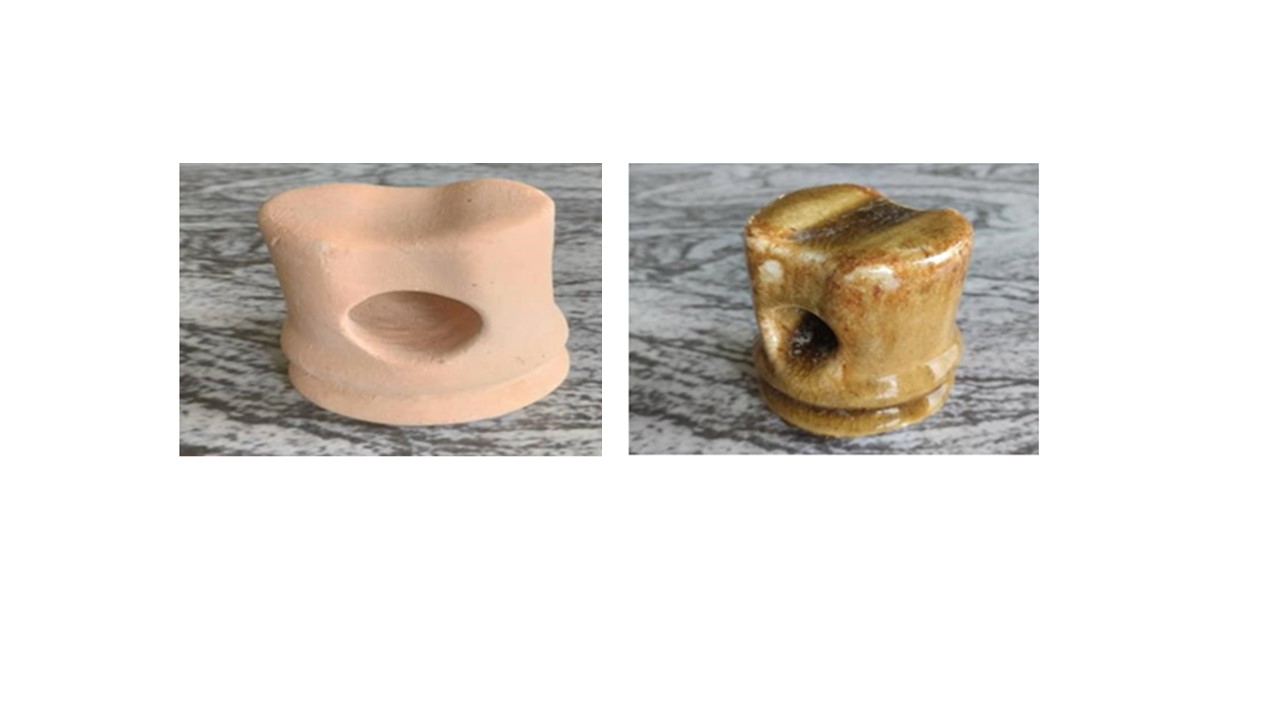
The production of electrical porcelain insulators in Nigeria relies heavily on imported materials like feldspar which increase the cost of production and purchasing price of electrical porcelain insulators. This study investigated the partial substitution of feldspar with Palm Bunch Ash (PBA), a silica-rich by-product of the palm oil industry to enhance sustainability and cost-effectiveness. Using local raw materials (kaolin, quartz, ball clay) and PBA at substitution ratios of 0%, 5%, 10%, 15%, and 20%, samples were prepared, fired at 900°C, and glazed at 1250°C. Mechanical properties (moisture content, plasticity, shrinkage, water absorption, porosity, density) and electrical properties (resistivity, dielectric strength) were evaluated. The results showed that 5% PBA substitution achieved optimal performance, with a resistivity of 2.92 × 10¹⁴ Ω-m and dielectric strength of 9.0 kV/mm, comparable to conventional insulators, while reducing raw material costs by 20%. Higher PBA levels increased porosity, compromising insulation efficiency. This approach leverages local waste to address resource constraints, aligning with circular economy principles and supporting Nigeria’s power sector. This is the first systematic evaluation of PBA as a feldspar substitute in Nigerian porcelain insulators, validating its role in circular economy-driven ceramic production.
References
Abuh, M. A., Abia-Bassey, N., Udeinya, T. C., Nwannewuihe, H. U., Abong, A. A., & Akpomie, K. G. (2014). Industrial potentials of Adiabo clay in Calabar municipal of Cross River State, South-South Nigeria. Pacific Journal of Science and Technology, 15(1), 63-75.
Almeida, F., Soares, P., & Moreira, M. (2020). Effect of firing temperature on the porosity and mechanical properties of porcelain insulators. Journal of Ceramic Science and Technology, 11(4), 1-10.
Etukudoh, A. B., Akpomie, K. G., & Okereke, O. C. B. (2016). Characterization of Ezzodo clay deposit for its industrial potentials. International Journal of Advanced Engineering Research and Technology, 4(7), 234-241.
Hill, R. (2023). The mathematical theory of plasticity. Oxford University Press. https://doi.org/10.1093/oso/9780198503675.001.0001
Ismail, Z., Raza, H., & Jamil, M. (2021). Effect of Palm Bunch Ash on the mechanical properties and porosity of ceramic materials. Ceramics International, 47(5), 6559-6565.
Jones R. H., McCubbin F. M., Dreeland L., Guan Y., Burger P. V., and Shearer C. K. (2014). Phosphate minerals in LL chondrites: A record of the action of fluids during metamorphism on ordinary chondrite parent bodies. Geochimica et Cosmochimica Acta 132(2), 120–140.
Liu, X., Yang, Z., & Zhang, H. (2019). Influence of composition on the dielectric properties of porcelain insulators. Materials Research Bulletin, 120, 110591.
Nelson, E. S., Iyuke, S., Daramola, M. O., & Okewale, A. (2023). Extraction and characterization of silica from empty palm fruit bunch (EPFB) ash. Processes, 11(6), 1684. https://doi.org/10.3390/-pr11061684
Olugbade, A., Alabi, O., & Olorunfemi, A. (2018). Density and porosity characteristics of modified porcelain ceramics. International Journal of Ceramic Engineering and Science, 5(2), 103-110.
Oosterveer, P. (2015). Promoting sustainable palm oil: Viewed from a global networks and flows perspective. Journal of Cleaner Production, 107, 146-153. https://doi.org/10.1016/j.jclepro.2015.05.058.
Silva, J. C., Ulsen, C., Bergerman, M. G., & Horta, D. G. (2019). Reduction of Fe2O3 content of foyaite by flotation and magnetic separation for ceramics production. Journal of Materials Research and Technology, 8(5), 4915-4923. https://doi.org/10.1016/j.jmrt.-2019.07.062
Wang, J., Li, L., & Xu, D. (2020). Performance evaluation of high-voltage porcelain insulators with various fillers. Journal of Materials Science, 55(13), 5417-5427.
Warr, L. N. (2021). IMA–CNMNC approved mineral symbols. Mineralogical Magazine, 85(3), 291–320. https://doi.org/10.1180/mgm.2021.43
Downloads
Published
How to Cite
Issue
Section
License
Copyright (c) 2026 Researchers Journal of Science and Technology

This work is licensed under a Creative Commons Attribution-NonCommercial-NoDerivatives 4.0 International License.
Unless a different licence is clearly indicated for a particular article, articles published in the journal are made available under the Creative Commons Attribution 4.0 International (CC BY 4.0) licence. This licence permits others to read, download, copy, distribute, share, adapt, and build upon the published work, including for commercial purposes, provided that appropriate credit is given to the original author(s), the article is properly cited, and any changes made to the original work are clearly indicated.